Genre
Modal Jazz
Late 1950s onward — New York — Open, spacious, meditative
Modal jazz swaps the rapid-fire chord changes of bebop for scales — modes — that give musicians room to breathe, explore, and think. Instead of racing through a sequence of harmonies, players settle into a tonal center and see what they can build there. The result is music that feels slower in the best way: deliberate, searching, and often surprisingly deep.

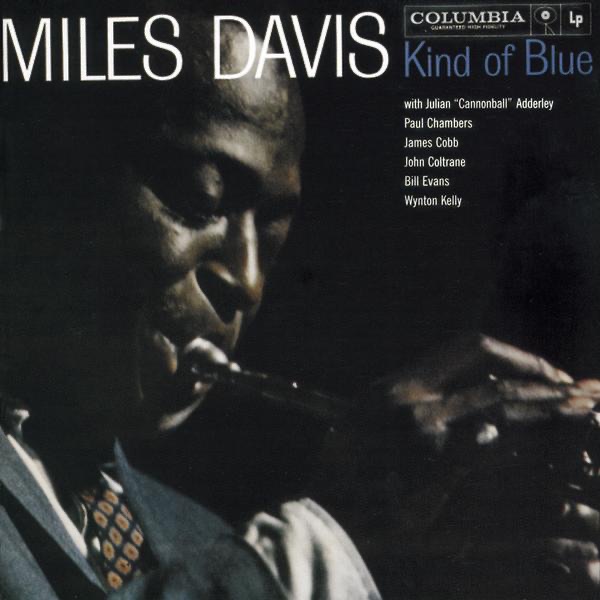
The key document is Kind of Blue (1959) by Miles Davis, and it's worth understanding what exactly changed. Bebop players like Charlie Parker had turned jazz into a high-speed obstacle course of chord substitutions. Brilliant, yes, but also exhausting to play and sometimes exhausting to follow. Miles, working with ideas that Bill Evans and George Russell had been developing around modes and scales, created a record where the musicians had just one or two chords per section to work with — sometimes for minutes at a time. The improvisers had to find their own direction rather than follow a harmonic map. Kind of Blue sold more copies than almost any jazz record before or since, which tells you that a lot of listeners were ready for this.
What modes actually are is simpler than music theory makes it sound. A mode is just a scale starting on a different note — the Dorian mode, the Mixolydian mode, and so on, each with its own character. When John Coltrane was still in Miles's band, he was absorbing all of this, and what he did with it afterward was more intense than anything Miles had in mind. Coltrane's A Love Supreme (1965) and the records leading up to it show a musician using modal openness not for relaxation but for obsessive, almost spiritual investigation. He'd take a single idea and turn it over and over until he'd found everything in it. That's very different from the cool elegance of Kind of Blue, but both are possible because modal structure gives you the space.
McCoy Tyner deserves a lot of credit for how modal jazz actually sounds in practice — specifically, that big, quartal left hand, stacking fourths instead of thirds, which became the signature voicing of the whole movement. His work with Coltrane's classic quartet set a harmonic template that pianists are still using today. Meanwhile, Herbie Hancock was doing something related but more groove-oriented, especially on Maiden Voyage (1965), which takes modal ideas and makes them feel light and airy rather than intense. That record is a good reminder that modal jazz covers a wide range — it's a structural approach, not a single mood.
The influence of modal jazz is hard to overstate because it gave later musicians a tool that worked across genres. When rock and funk musicians in the late 1960s and 1970s started talking to jazz, modal thinking was part of why the conversation was possible — a vamp on one or two chords is something a rock band understands. Miles Davis's electric records of that period, like In a Silent Way (1969), are modal jazz stretched almost past recognition, blended with studio editing and electric instruments. But the core idea — stay in a key center, find your own way through it — never went away. You can hear it in contemporary players who might not even think of themselves as modal, because at this point it's just part of the vocabulary.
When the chord changes stop telling you where to go, you find out what you actually have to say.
Essential Albums
♫
Kind of Blue
Miles Davis · 1959
The record that defined modal jazz for the wider world, built on modes and space rather than bebop chord changes, and still the entry point for anyone curious about the style.
♫
Maiden Voyage
Herbie Hancock · 1965
Shows the airy, unhurried side of modal jazz — every track breathes, and Hancock's composing makes the whole approach feel like an invitation rather than a challenge.
♫
A Love Supreme
John Coltrane · 1964
Coltrane takes the modal framework and turns it into something searching and unrelenting — a four-part suite that shows how much intensity the open structure could hold.
♫
Speak No Evil
Wayne Shorter · 1966
Shorter's compositional approach to modal jazz is more harmonically ambiguous than most — his tunes give the soloists unusual shapes to work with, and the results feel genuinely unpredictable.
In This Genre
42 artists in your library♫
Yonathan Avishai
Piano · Israel / France · Contemporary Jazz
Yonathan Avishai plays piano like he has all the time in the world, and somehow that patience makes every note land harder. Born in Israel and now based in Paris, he has built a reputation as one of the more quietly distinctive voices in contemporary European jazz — the kind of player you notice not because he's doing something loud, but because he keeps doing something right. His music sits in the space between restraint and feeling, and it rarely sounds like anything else.
♫
Gary Bartz
Alto Saxophone - USA - Hard Bop / Soul Jazz
Gary Bartz has been making uncompromising alto saxophone music since the 1960s, moving through hard bop, funk-inflected soul jazz, and back again without ever losing the thread. He came up through some of the most demanding bands in jazz history — playing with Max Roach, Art Blakey, and then Miles Davis at the turn of the 1970s — and what he learned in those rooms still shows up in every solo he plays. If you know his name at all, you probably know him from one great record, but his story is a lot longer and stranger than that.
♫
Nat Birchall
Saxophone - England - Spiritual Jazz
Nat Birchall didn't come up through conservatories or big bands — he came up through Manchester's reggae sound systems before John Coltrane rewired his head for good. What followed was decades of quiet, devoted work building a sound that owes everything to spiritual jazz's deepest wells and almost nothing to trend.
♫
Brian Blade
Drums - USA - Post-Bop
Brian Blade grew up in Shreveport, Louisiana, the son of a Pentecostal preacher, and you can hear that upbringing in every drumset he sits behind. He plays with the patience of someone who knows when to hold back and the release of someone who really means it when he finally lets go. Over the past three decades he has become one of the most sought-after drummers in jazz, not by being flashy, but by being exactly what the music needs.
♫
Anouar Brahem
Oud - Tunisia - Contemporary Jazz
Anouar Brahem has spent four decades quietly doing something most musicians never pull off: making the oud sound completely at home in jazz without sacrificing what makes the instrument distinctly itself. His records for ECM have a stillness to them that borders on radical — long melodic lines, lots of space, and a palette that draws from Arabic maqam traditions as naturally as it does from modal jazz. He is not trying to bridge two worlds so much as he has built his own.
♫
Joe Chambers
Drums & Vibraphone — USA — Post-Bop
Joe Chambers spent years as one of the most in-demand drummers in New York without ever becoming a household name, which tells you something about how jazz rewards certain kinds of visibility over others. He played on a staggering run of Blue Note records in the 1960s without being the guy anyone put on the poster. Later in his career he turned seriously to the vibraphone, and the results were good enough to make you wonder why he waited.
♫
Jon Christensen
Drums - Norway - Nordic Jazz
Jon Christensen never hit a drum like he was trying to prove something. He played like he had all the time in the world, which is exactly why half of Europe's best pianists and saxophonists wanted him behind them. If you've ever heard an ECM record and thought the drums sounded unusually spacious and unhurried, there's a decent chance it was him.
♫
Jimmy Cobb
Drums - USA - Hard Bop / Modal Jazz
Jimmy Cobb spent decades being the steadiest hand in the room, and the room was often the most important room in jazz history. He's the drummer on Kind of Blue, which means more people have heard his playing than almost any other drummer alive or dead — most of them without ever knowing his name. That anonymity suited him fine; Cobb was never about the spotlight, he was about making the music feel inevitable.
John Coltrane
Tenor & Soprano Saxophone · USA · Hard Bop, Modal, Avant-Garde
John Coltrane didn't just play music — he interrogated it, pulling at its seams until something transcendent came loose. From the scorching bebop of his Miles Davis years to the devotional storms of A Love Supreme, he compressed a lifetime of evolution into barely two decades of recording. No saxophonist before or since has made the instrument sound simultaneously so human and so far beyond it.
Miles Davis
Trumpet · USA · Modal / Jazz Fusion
More than any other figure in jazz, Miles Davis treated reinvention as a moral obligation — each decade brought a new sound, a new band, a new argument about where music should go. He had the rare gift of hearing the future before anyone else, and the rarer gift of making others feel it too. To trace his career is to trace the entire arc of modern jazz itself.

Bill Evans
Piano · USA · Modal Jazz, Impressionism
Bill Evans reimagined the piano trio as a conversation among equals, dissolving the boundary between soloist and accompanist into something closer to chamber music. His touch was so intimate it seemed to come from inside the instrument rather than on top of it. In a career shadowed by personal tragedy, he turned introspection itself into a formal technique.
♫
Gil Evans
Arranger/Pianist - Canadian/American - Cool Jazz
Gil Evans didn't solo much and barely wrote conventional melodies, but he reshaped how jazz could sound when a whole orchestra breathed as one instrument. He's the quiet architect behind some of the most beautiful records Miles Davis ever made, and a guy who kept reinventing himself well into his sixties.

Ryo Fukui
Piano - Japan - Modal Jazz, Fusion
Ryo Fukui was a virtuoso pianist whose melodic sophistication and harmonic daring positioned him as a singular voice in 1970s Japanese jazz. Working largely outside the international spotlight, he crafted albums of stunning inventiveness—modal explorations and fusion experiments that anticipated wider conversations about jazz's global future. His rediscovery in recent years has revealed an artist of remarkable depth and prescient vision.
♫
Jimmy Garrison
Bass - USA - Modal Jazz
Jimmy Garrison spent the most important years of his career holding down the bottom end of one of the most demanding groups in jazz history, and he did it without ever calling attention to himself. He was the bassist in John Coltrane's classic quartet, the one who had to keep something resembling a center while Coltrane and McCoy Tyner and Elvin Jones were pulling in every direction at once. That he managed it — and made it sound natural — says everything about how good he was.

Dexter Gordon
Tenor Saxophone - USA - Hard Bop & Bebop
Dexter Gordon was the tenor saxophone's poet laureate—a towering figure whose warm, conversational tone and harmonic sophistication made him one of jazz's greatest improvisers. After decades of struggle with addiction and a self-imposed exile in Copenhagen, he returned to America in the 1970s to cement a legacy that would influence generations of saxophonists. His late-career renaissance proved that artistic greatness could survive almost anything.
♫
Matthew Halsall
Trumpet - England - Spiritual Jazz
Matthew Halsall makes jazz that sounds like it was recorded in a garden after rain — unhurried, modal, full of space. He built his own label to release it, which tells you something about how little interest he has in fitting into anyone else's idea of what British jazz should sound like.
♫
Chico Hamilton
Drummer - United States - Cool Jazz
Chico Hamilton never chased flash on the drums, but he had an ear for putting the right strange combination of instruments in a room together and getting magic out of it. He's the guy who put a cello in a jazz group and made it sound completely natural, then spent the next five decades finding young unknowns and letting them run wild in his band.

Joe Henderson
Tenor Saxophone - United States - Modal Jazz & Hard Bop
Joe Henderson was a tenor saxophonist of extraordinary harmonic sophistication and restless creativity, a musician who refused the constraints of any single style. From his early work in the hard bop tradition through his explorations of modal jazz and beyond, Henderson embodied an intellectual rigor that made him one of the most respected and influential saxophonists in modern jazz history.

Bobby Hutcherson
Vibraphone - United States - Modal Jazz, Soul Jazz
Bobby Hutcherson was the vibraphone's poet laureate, transforming the instrument from a rhythmic accompanist into a vehicle for lyrical expression and harmonic sophistication. His liquid tone and intuitive sense of space made him one of the most recorded vibraphonists in jazz history, equally at home in modal explorations and soul-inflected grooves. For five decades, Hutcherson proved the vibraphone could sing with the depth and nuance of any horn.

Ahmad Jamal
Piano - United States - Modal Jazz & Hard Bop
Ahmad Jamal transformed the jazz piano trio into an art form of elegant restraint and architectural precision. His crystalline touch and sophisticated harmonic sensibility made him a bridge between swing-era sophistication and modal modernism. For seven decades, he proved that space and silence could be as powerful as virtuosity.
♫
Rudolph Johnson
Tenor Saxophone - United States - Spiritual Jazz
Rudolph Johnson cut two albums for Black Jazz Records in the early seventies and then more or less vanished from the jazz conversation, which is a shame, because those records are some of the warmest, most soulful tenor playing to come out of that whole spiritual jazz moment. He never chased a bigger name for himself. He just played with real conviction and let the tape roll.

Elvin Jones
Drums - USA - Modal Jazz & Free Jazz
Elvin Jones was the propulsive heartbeat of John Coltrane's classic quartet, a drummer whose polyrhythmic intensity and seemingly telepathic interplay with his bandmates redefined what percussion could achieve in jazz. His approach—simultaneously swinging and free, supportive yet solistically adventurous—became the blueprint for generations of jazz drummers seeking to balance musicality with raw power.
♫
Masabumi Kikuchi
Piano - Japan - Post-Bop / Free Jazz
Masabumi Kikuchi spent decades building a reputation as one of Japan's most serious jazz pianists, but the music he made in the last chapter of his life is where things get genuinely strange and remarkable. He stripped everything back — no rhythm section, long silences, tones that seem to dissolve before they resolve — and arrived at something that sounds like no one else. If you come to him expecting swing or even conventional post-bop, you'll need to adjust your ears.
♫
Dave Liebman
Saxophone - United States - Post-Bop / Jazz Fusion
Dave Liebman spent two years in the early '70s standing next to Miles Davis, playing soprano saxophone inside some of the loudest, most unresolved electric music jazz ever produced. He came out the other side and spent the next five decades building a career that's part saxophonist, part teacher, part obsessive student of harmony. If you want to hear what happened to saxophone playing after John Coltrane left the building, Liebman is a good place to start.
♫
Alfred Lion
Producer - German-American - Record Label Founder
Alfred Lion didn't play a note on any of the records that made him famous, but good luck finding a jazz collection without his fingerprints on it. He started Blue Note out of love for the music, stuck around long enough to define what a modern jazz record could sound like, and somehow never lost the enthusiasm of a guy who just heard something amazing in a club the night before.
♫
Booker Little
Trumpet - USA - Post-Bop
Booker Little died at 23, which means most people file him under 'tragic genius' and move on. That's a shame, because what he left behind is genuinely strange and exciting music that doesn't sound like anyone else from that period. He was working out ideas that most trumpeters wouldn't catch up to for years.
♫
Bennie Maupin
Reeds & Woodwinds - USA - Modal Jazz / Jazz Fusion
Bennie Maupin is the kind of musician other musicians know about even when the general public doesn't. He played bass clarinet on one of the most important jazz albums ever made, spent years as the spine of Herbie Hancock's Mwandishi band, and built a solo career that quietly rewarded anyone paying close attention.
♫
Donny McCaslin
Saxophone - United States - Jazz Fusion
Donny McCaslin spent decades as one of the most respected tenor players in New York before most casual listeners ever heard his name — then David Bowie called, and everything changed overnight. He's the rare saxophonist equally comfortable inside a knotty Maria Schneider chart and a synth-heavy rock arrangement, and he's spent his solo career trying to smash those worlds together on purpose.
♫
Ken McIntyre
Alto Saxophone - United States - Avant-Garde Jazz
Ken McIntyre spent as much time in classrooms as he did on bandstands, and you can hear it in his playing — careful, searching, never showing off just to show off. He cut one of the great lost records of 1960 with Eric Dolphy, then more or less vanished from the center of the jazz conversation while he built a teaching career, before resurfacing decades later with a run of records for a Danish label that nobody talks about enough.
♫
Milton Nascimento
Vocals / Guitar — Brazil — MPB / Latin Jazz
Milton Nascimento has one of those voices you hear once and never quite shake — a falsetto that can drop into a warm baritone mid-phrase, somehow sounding like a choir even when he's singing alone. Coming out of Minas Gerais in the late 1960s, he fused Brazilian folk tradition, Catholic church music, and jazz harmony into something that didn't have a name at the time. He became one of the central figures of the Clube da Esquina movement and eventually pulled in collaborators from Wayne Shorter to Herbie Hancock without ever losing what made him sound like himself.
♫
Oliver Nelson
Saxophone, Arranger - USA - Post-Bop, Hard Bop
Oliver Nelson wore more hats than most musicians manage in a lifetime — saxophonist, composer, arranger, bandleader, film and television scorer — and he wore all of them well. He is best remembered for one album that pretty much everyone agrees is a stone classic, but his real story is wider and stranger than that single record suggests. Here was a guy who could write for a small jazz combo and a full symphony orchestra with equal confidence, and who quietly shaped the sound of dozens of records without his name ever appearing on the front cover.
♫
Emile Parisien
Soprano Saxophone - France - Contemporary Jazz
Emile Parisien picked an instrument that most modern jazz players treat as a side hustle and made it his whole voice. His soprano sax playing is fast, funny, a little unhinged at the edges, and it has made him one of the most fun French jazz musicians to watch live in the last two decades.
♫
Danilo Pérez
Piano - Panama - Latin Jazz
Danilo Pérez plays piano like someone who grew up with a marching band in one ear and Thelonious Monk in the other — because he did. He's spent decades finding the seams between Panamanian folk rhythm and modern jazz harmony, and along the way became one of the most trusted pianists Wayne Shorter ever worked with.
♫
Miles Davis Quintet
Ensemble - USA - Hard Bop / Post-Bop
The Second Great Quintet — as people eventually started calling it — was one of those rare bands where everyone in the room was operating at the same level at the same time, which almost never happens. Miles Davis had done it before with different players, but this group had a particular chemistry that made even rehearsed material sound like it was being invented on the spot. Five years, a handful of studio records, and a mountain of live recordings later, they stopped before they wore it out.

Sonny Rollins
Tenor Saxophone - United States - Hard Bop & Modal Jazz
Sonny Rollins is the saxophone colossus whose improvisational prowess and harmonic sophistication redefined what the tenor could express. With an uncompromising approach to melody and a willingness to deconstruct standards into their essential components, he became one of jazz's greatest composers and interpreters. His career spans seven decades of relentless innovation, from bebop's early days to contemporary explorations.
♫
George Russell
Composer/Theorist - American - Modal Jazz
George Russell started out as a drummer and ended up rewriting the rulebook for how jazz musicians think about scales and harmony. His theory book changed the way Miles Davis and Bill Evans approached improvising, even though most people who bought their records never heard his name.
♫
Woody Shaw
Trumpet - USA - Post-Bop / Modal Jazz
Woody Shaw was doing things on the trumpet in the 1970s and 80s that almost nobody else was even attempting — reaching into whole-tone scales and quartal harmonies at a time when most of his peers were either playing it safe or chasing fusion money. He built a sound that felt genuinely modern without abandoning swing, which is a harder trick than it sounds. The tragedy is that he never quite got the recognition he deserved while he was alive, and the music still sounds ahead of its time.

Wayne Shorter
Saxophone & Composition - USA - Hard Bop to Fusion
Wayne Shorter was a tenor and soprano saxophonist whose restless compositional mind refused easy categorization across seven decades. Whether in the austere modernism of Art Blakey's messengers, the modal sophistication of Miles Davis's second great quintet, or the electrified experimentalism of Weather Report, Shorter carved a path defined by intellectual rigor and spiritual searching. His melodies were angular and unpredictable; his sound was lean and penetrating; his vision was uncompromising.
♫
Gabor Szabo
Guitar · Hungary · Modal Jazz / World Fusion
Gabor Szabo played guitar like someone who had learned jazz in a foreign language and kept both accents. He arrived in the US after the 1956 Hungarian Revolution, landed in Berklee, and spent the next two decades making music that didn't quite fit anywhere — too modal for the pop crowd, too folk-flavored for the hard boppers, and too strange to be easily filed away.

McCoy Tyner
Piano - United States - Modal Jazz, Free Jazz
McCoy Tyner was the architectural mind behind John Coltrane's most visionary recordings, a pianist whose massive hands and harmonic innovation redefined what the instrument could do in a modal context. His approach—stacked quartal chords, torrential runs, and a rhythmic independence that locked into grooves while soaring above them—became the blueprint for generations of jazz pianists. Beyond his legendary work with Coltrane, Tyner built a solo career that spanned six decades, proving himself one of the most consequential voices in post-bop jazz.
♫
Kamasi Washington
Tenor Saxophone · USA · Spiritual Jazz / Neo-Soul
Kamasi Washington arrived fully formed in 2015 with a triple album that made a lot of people realize jazz hadn't gone anywhere — they'd just stopped looking. A product of the fertile South Los Angeles music scene, he brings the ambition of John Coltrane's modal period into a world shaped by hip-hop, gospel, and the sprawling creative community around Kendrick Lamar.

Tony Williams
Drums - United States - Modern Jazz, Fusion
Tony Williams transformed the role of the drummer from timekeeper to equal voice in the conversation, wielding his kit as an instrument of harmonic and melodic sophistication. His work with Miles Davis's Second Great Quintet and his own groups redefined what was possible on drums, creating a template for rhythmic innovation that continues to influence musicians across genres.