Strange Tunings, Open Roads
Szabo grew up in Budapest listening to Hungarian folk music and American jazz on whatever radio signals he could pull in from behind the Iron Curtain. When he finally got to the States and enrolled at Berklee in 1958, he had this deeply personal hybrid already forming — he just needed the right context to let it out. His playing didn't sound like any of his American contemporaries. He bent notes in ways that suggested Hungarian scales rather than blues scales, used open string drones that gave his lines a sitar-like resonance, and would shift into rubato passages mid-phrase without warning. It was disorienting in the best way.
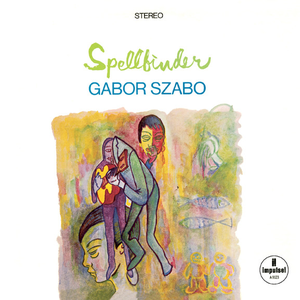
His early work with Chico Hamilton in the early 1960s gave him a platform that actually suited him. Hamilton's group was already interested in texture and space rather than hard-swinging changes, so Szabo's restless, modal playing had room to breathe. He then moved through Charles Lloyd's band — another outfit comfortable with open forms — before striking out on his own for Impulse! Records. His Impulse! run produced some genuinely great records, especially Spellbinder (1966), where he plays with a looseness and confidence that he'd spend the rest of his career chasing.
Spellbinder (1966) is the record to start with if you haven't heard him. It's got this one-take looseness that makes everything feel improvised even when it isn't. His cover of Burt Bacharach's "What the World Needs Now" is one of the strangest and best versions of that song anyone's recorded — he strips out the sentiment and turns it into something almost meditative. The band is tight but not stiff. Jimmy Stewart on rhythm guitar keeps things grounded while Szabo wanders wherever he wants.
By the late 1960s and into the 1970s, Szabo made a deliberate move toward pop accessibility that puzzled some of his jazz fans. He covered Joni Mitchell, Carlos Santana, and even Hendrix. Some of it works better than you'd expect — his version of "Light My Fire" on Bacchanal (1968) has genuine heat to it. Some of it feels like a talented artist trying too hard to stay commercially relevant in a shifting market. But even the more accessible records have these moments where his Hungarian folk instincts break through and remind you that nobody else played guitar quite like this.
He moved back to Hungary in the late 1970s, struggled with health issues, and died in Cleveland in 1982 at 45. His catalog has been quietly influential — Carlos Santana has cited him as a major influence on his approach to melody, and you can hear Szabo's open-string drone technique in a lot of world-influenced guitarists who came after him. He's one of those musicians who was never quite famous enough, never quite categorized correctly, and whose records keep sounding fresher the further you get from the era he was working in.