Where do you listen?
Choose your streaming service
inside the sleeve
Loading…
inside the sleeveITS
⌕
Read About
Saxophone, Arranger - USA - Post-Bop, Hard Bop

Oliver
Nelson

Start here The Blues and the Abstract Truth (1961) →
1932 - 1975, USA

Oliver Nelson wore more hats than most musicians manage in a lifetime — saxophonist, composer, arranger, bandleader, film and television scorer — and he wore all of them well. He is best remembered for one album that pretty much everyone agrees is a stone classic, but his real story is wider and stranger than that single record suggests. Here was a guy who could write for a small jazz combo and a full symphony orchestra with equal confidence, and who quietly shaped the sound of dozens of records without his name ever appearing on the front cover.

Hard BopPost-BopModal JazzSoul Jazz
Oliver Nelson

The Arranger Who Could Play

Nelson grew up in St. Louis, came up through rhythm and blues bands, and then put in serious time studying composition formally — both at Washington University and at Lincoln University. That combination of street-level gigging and academic training is all over his music. He could swing hard and write a precise, almost classical voicing in the same breath. By the time he landed in New York in the late 1950s, he had something a lot of the bebop generation lacked: a genuine command of large-scale writing.

The album everyone knows is The Blues and the Abstract Truth (1961), recorded for Impulse! with a lineup that included Freddie Hubbard, Eric Dolphy, Bill Evans, and Roy Haynes. That is not a band you assemble by accident. The record has this quality of being simultaneously tight and loose — the arrangements give everyone a clear lane but nobody sounds boxed in. The title track alone, with its simple blues form stretched into something more spacious and deliberate, gives you a clear idea of what Nelson was after: structure that breathes.

What sometimes gets lost is how good a saxophonist Nelson actually was. He had a big, slightly dry tenor tone — not as raw as Sonny Rollins, not as searching as John Coltrane, but immediately identifiable. His alto playing leaned cooler and more precise. He was never going to be the most talked-about horn player of his generation, but on his own sessions he held his own against serious company without any apparent effort.

Through the 1960s, Nelson moved increasingly into studio work and television scoring, eventually relocating to Los Angeles. He wrote for shows like Ironside and The Six Million Dollar Man, and scored a number of films. Some jazz purists treated this as a kind of sellout, which was always a bit unfair. Nelson was doing what a working musician with broad skills does — he took the work seriously and he was very good at it. He also kept recording jazz when he had the chance, with sessions for Impulse! and Flying Dutchman that showed he had not lost the thread.

He died in 1975 at 43, which is young enough to make you wonder what the second half of his career might have looked like. He was getting more comfortable moving between the commercial world and the jazz world on his own terms, and his arranging skills were still clearly developing. What remains is a catalog that rewards digging past the obvious entry point — there are later records and sideman appearances that most listeners have never heard, and they hold up.

Facts
BornJune 4, 1932, St. Louis, Missouri
DiedOctober 27, 1975, Los Angeles, California
InstrumentTenor & Alto Saxophone, Clarinet, Arranger/Composer
Active1950s – 1975
Known forThe Blues and the Abstract Truth, large-scale jazz arranging, film and TV scoring
Connections
Eric DolphyCollaborator, New York
→
Freddie HubbardCollaborator, New York
→
Bill EvansCollaborator, New York
→
Read more

Discography

26 records
Taking Care of Business
1960
♫
These Dues
1961
Blue Seven
Blue Seven
1961
More Blues and the Abstract Truth
1961
The Blues and the Abstract Truth
1961
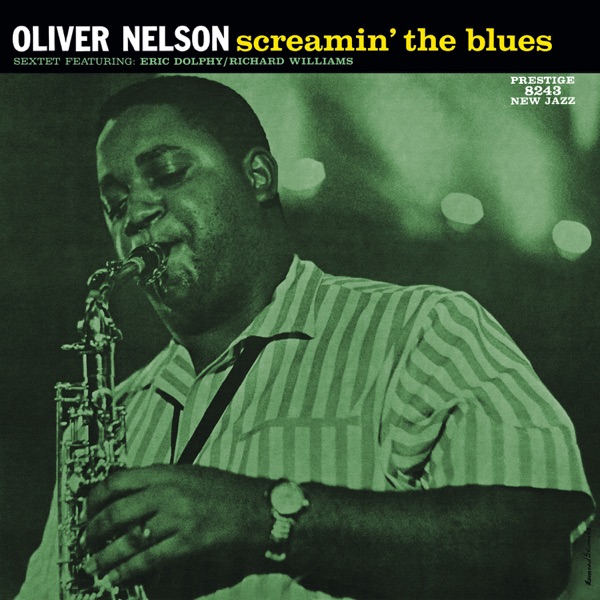
Screamin' the Blues
Screamin' the Blues
1961
Main Stem
Main Stem
1962
♫
Afro/American Sketches
1962
Full Nelson
Full Nelson
1962
Impressions of Phaedra
1962
Sound Pieces
Sound Pieces
1966
Oliver Nelson Plays Michelle
1966
♫
Leonard Feather Presents the Sound of Feeling and the Sound of Oliver Nelson
1966
Live From Los Angeles
1967
Soulful Brass
Soulful Brass
1968
Black Brown and Beautiful
1970
♫
The Mayor and the People
1970
Berlin Dialogue for Orchestra
1971
The Spirit of '67
The Spirit of '67
1972
Swiss Suite
Swiss Suite
1973
♫
Oliver Edward Nelson in London With Oily Rags
1974
♫
In Person
1974
Stolen Moments
Stolen Moments
1975
Skull Session
Skull Session
1975
Fantabulous
Fantabulous
2008
♫
3-2-1-0
2008

Collaborations

Live on Youtube

Explore Further

Selected connections
Saxophonist, USA
Wayne Shorter
If Nelson's balance of compositional discipline and jazz feeling appeals to you, Shorter is the next logical step — a writer-player who pushed the same tension further.
Explore →
Album, 1965
Sound Pieces
A less-celebrated Nelson record that shows his arranging range beyond the famous Impulse! session — worth hearing back to back with The Blues and the Abstract Truth.
Explore →
Arranger/Composer, USA
Gil Evans
The other great mid-century jazz arranger with classical ambitions — comparing Evans and Nelson reveals two completely different answers to the same question about how jazz and orchestration can coexist.
Explore →

Who's playing
Listen next
Recording Info
Track listing
Musicians
Further Reading
Read more

Where next?

More by this artist

Albums with the same musicians

From the same era

Similar artists

inside the sleeve
Growing
Jazz, explained without pretension.
Read · Follow the connections · Press play
Right now: 7,100+ albums · 440+ artists
Start here
New to jazz? These artists are good places to start.
Loading…
Explore
Nine records worth getting lost in.
Born today
Album of the day
A landmark record, every day.
Read
  • Loading…
Article archive →
Recently added
Purpose
Inside the Sleeve is your companion on a journey through jazz — not a textbook, but something closer to a knowledgeable friend sitting next to you while you listen. Read about an artist, press play, follow a connection, discover an album you didn't know you needed.
Suggestions
Read

Articles

Essays, guides, and lists about jazz and the records that matter.

Loading…

Genre

Key Artists
Further Reading

Essential Albums

Related Genres

In This Genre

About

Inside the Sleeve

Work in progress

Inside the Sleeve grows continuously — new artists and albums are added, essays refined, as visitors explore and our editors follow up on what they find. Content, features, and design are still evolving; use the Report error button on any page to flag something that seems off.

Content

Every artist, album, and release date on Inside the Sleeve is real — verified against trusted sources including MusicBrainz and Wikipedia. We don't invent discographies or fabricate records. AI compiles that verified information into readable prose — essays on artists, albums, and the music itself. We can't manually review every essay before publishing, but every reported error is checked by a human editor.

Inside the Sleeve is not a review site. We're not here to rate or rank — we're here to guide you in. Where an album stands out, we'll say so. Where an artist changed everything, you'll know why. But we won't tear anything down. Jazz history is complex and sources sometimes disagree — if you spot something that seems off, please report it.

Streaming

Inside the Sleeve links to Spotify and Apple Music so you can listen while you read. These are not affiliate links. For Spotify, links open a search on open.spotify.com — we do not have direct links to specific recordings. For Apple Music, direct links are used where available, otherwise a search is opened.

Your choice of streaming service is stored locally in your browser only. It is never sent to our servers.

We're working on deeper Spotify integration, including direct links to specific recordings.

Privacy

Inside the Sleeve does not collect personal data and does not use cookies. We count page visits anonymously using a self-hosted analytics tool — no personal identifiers are stored, and the data never leaves our own server. The only preference stored on your device is your streaming service choice, saved locally in your browser and never transmitted.

When you submit a suggestion or error report, the text you write is stored in our database. No name or email is required or collected unless you choose to provide one.

Third-party services

Spotify and Apple Music are independent services with their own terms of use and privacy policies. Inside the Sleeve is not affiliated with or endorsed by either company.

Support

Inside the Sleeve is free and ad-free. If you enjoy it, a coffee helps cover server costs and keeps the project going.

Amazon

Some book recommendations on Inside the Sleeve link to Amazon. Buying through these links costs you nothing extra — but Amazon pays us a small commission, which goes directly towards keeping the site running. It's a simple way to support the project if you were going to buy the book anyway.

As an Amazon Associate, Inside the Sleeve earns from qualifying purchases.

Questions or feedback? Use the suggestion box on the front page.

Inside the Sleeve — A guide for those who want to go beyond the obvious About & Privacy