Where do you listen?
Choose your streaming service
inside the sleeve
Loading…
inside the sleeveITS
⌕
Read About
Drums - United States - Modern Jazz, Fusion

Tony
Williams

1945 - 2017, Chicago, Illinois, United States

Tony Williams transformed the role of the drummer from timekeeper to equal voice in the conversation, wielding his kit as an instrument of harmonic and melodic sophistication. His work with Miles Davis's Second Great Quintet and his own groups redefined what was possible on drums, creating a template for rhythmic innovation that continues to influence musicians across genres.

Modal JazzJazz FusionAvant-Garde Jazz
Tony Williams

The Drummer as Composer

Tony Williams showed up at Miles Davis's place in 1963 when he was just seventeen, and he already sounded like someone who'd been doing this for decades. What made him different was how he played time—instead of sitting on the beat like most drummers, he'd float above it and below it, almost like he was dancing around the pocket rather than living in it. That one thing changed everything about what the drums could do in a band. On records like E.S.P. (1965) and Miles Smiles (1966), you hear it clearly: the drums aren't just keeping time anymore. Williams listens to what Miles and Wayne Shorter are playing harmonically and melodically, and he responds to it. He's soloing just as much as they are.

When he led his own groups—check out Emergency! (1963) and The Joy of Uplifting—you get a fuller picture of what was in his head. He treated the drums like a melodic instrument, the same way a pianist thinks about melody and phrasing. He'd use cross-rhythms, drop the volume suddenly, change textures. Nothing felt like accompaniment. It all felt like conversation.

His reach went pretty far. He played with John McLaughlin, worked with Jack DeJohnette, did the V.S.O.P. thing. But here's what matters: he wasn't just about chops or doing complicated things. His real philosophy was about listening first. Play second. He'd sit in the pocket, respond to what everyone else was doing, use restraint. And somehow that restraint gave him more range, not less.

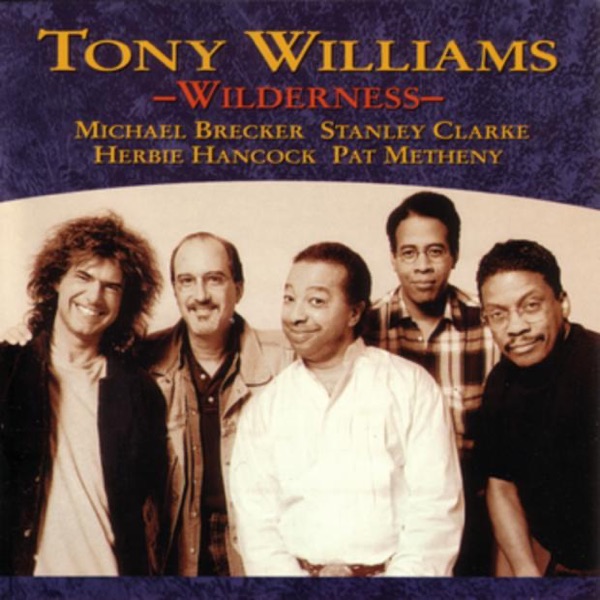
Later on, with albums like Civilization (1994) and Wilderness (1959), he kept pushing—blending straight jazz with more experimental sounds and textures. He never stopped asking himself what was possible. That's what his legacy really is: not a bunch of techniques to copy, but a question he left behind. What can the drums actually become if you really pay attention?

Facts
BornDecember 12, 1945, Chicago, Illinois
DiedFebruary 23, 1997, Los Angeles, United States
InstrumentDrums, percussion
Active1963 - 2017
Known forRevolutionizing drum technique in Miles Davis's Second Great Quintet; pioneering fusion and abstract rhythm
Connections
Miles DavisBandleader and mentor, New York
→
Herbie HancockPianist in Davis quintet, New York
→
Wayne ShorterSaxophonist in Davis quintet, New York
→
Jack DeJohnetteFellow revolutionary drummer, peer
→
John McLaughlinGuitarist, fusion collaborator
→
Read more

Discography

12 records
Ego
Ego
1959
Emergency!
Emergency!
1963
Life Time
Life Time
1964
The Joy of Flying
The Joy of Flying
1965
Spring
Spring
1965
Believe It
Believe It
1966
Angel Street
Angel Street
1966
Million Dollar Legs
Million Dollar Legs
1966
Ultimate Tony Williams
1987
Civilization
Civilization
1987
Wilderness
Wilderness
1996
♫
Can't Tell Me Nothing (The Official Mixtape, Mixed By Plain Pat)
2012

Collaborations

Live on Youtube

Explore Further

Selected connections
Album, 1966
Miles Smiles
The definitive Williams recording; his drumming reimagines rhythm in modal jazz.
Explore →
Album, 1964
E.S.P.
Williams's debut with Davis; introduces his floating approach to timekeeping.
Explore →
Album, 1975
Civilization
Williams as leader; demonstrates his compositional voice and continued evolution.
Explore →
Drummer, United States
Jack DeJohnette
The other transformative drummer of his generation; both expanded the instrument's vocabulary.
Explore →

Who's playing
Listen next
Recording Info
Track listing
Musicians
Further Reading
Read more

Where next?

More by this artist

Albums with the same musicians

From the same era

Similar artists

inside the sleeve
Growing
Jazz, explained without pretension.
Read · Follow the connections · Press play
Right now: 7,100+ albums · 440+ artists
Start here
New to jazz? These artists are good places to start.
Loading…
Explore
Nine records worth getting lost in.
Born today
Album of the day
A landmark record, every day.
Read
  • Loading…
Article archive →
Recently added
Purpose
Inside the Sleeve is your companion on a journey through jazz — not a textbook, but something closer to a knowledgeable friend sitting next to you while you listen. Read about an artist, press play, follow a connection, discover an album you didn't know you needed.
Suggestions
Read

Articles

Essays, guides, and lists about jazz and the records that matter.

Loading…

Genre

Key Artists
Further Reading

Essential Albums

Related Genres

In This Genre

About

Inside the Sleeve

Work in progress

Inside the Sleeve grows continuously — new artists and albums are added, essays refined, as visitors explore and our editors follow up on what they find. Content, features, and design are still evolving; use the Report error button on any page to flag something that seems off.

Content

Every artist, album, and release date on Inside the Sleeve is real — verified against trusted sources including MusicBrainz and Wikipedia. We don't invent discographies or fabricate records. AI compiles that verified information into readable prose — essays on artists, albums, and the music itself. We can't manually review every essay before publishing, but every reported error is checked by a human editor.

Inside the Sleeve is not a review site. We're not here to rate or rank — we're here to guide you in. Where an album stands out, we'll say so. Where an artist changed everything, you'll know why. But we won't tear anything down. Jazz history is complex and sources sometimes disagree — if you spot something that seems off, please report it.

Streaming

Inside the Sleeve links to Spotify and Apple Music so you can listen while you read. These are not affiliate links. For Spotify, links open a search on open.spotify.com — we do not have direct links to specific recordings. For Apple Music, direct links are used where available, otherwise a search is opened.

Your choice of streaming service is stored locally in your browser only. It is never sent to our servers.

We're working on deeper Spotify integration, including direct links to specific recordings.

Privacy

Inside the Sleeve does not collect personal data and does not use cookies. We count page visits anonymously using a self-hosted analytics tool — no personal identifiers are stored, and the data never leaves our own server. The only preference stored on your device is your streaming service choice, saved locally in your browser and never transmitted.

When you submit a suggestion or error report, the text you write is stored in our database. No name or email is required or collected unless you choose to provide one.

Third-party services

Spotify and Apple Music are independent services with their own terms of use and privacy policies. Inside the Sleeve is not affiliated with or endorsed by either company.

Support

Inside the Sleeve is free and ad-free. If you enjoy it, a coffee helps cover server costs and keeps the project going.

Amazon

Some book recommendations on Inside the Sleeve link to Amazon. Buying through these links costs you nothing extra — but Amazon pays us a small commission, which goes directly towards keeping the site running. It's a simple way to support the project if you were going to buy the book anyway.

As an Amazon Associate, Inside the Sleeve earns from qualifying purchases.

Questions or feedback? Use the suggestion box on the front page.

Inside the Sleeve — A guide for those who want to go beyond the obvious About & Privacy