Speed, Silence, and the Raga
Before McLaughlin became famous, he was already the guitarist other guitarists talked about. His early sessions in London placed him alongside Jack Bruce and others in the British blues and jazz underground, and when he moved to New York around 1969, Miles Davis immediately put him to work — first on In a Silent Way (1969), then on the seismic Bitches Brew (1970). On those records McLaughlin plays with a tightly wound intensity, always a little unpredictable, slipping between angular chord stabs and long single-note runs that sound like they're thinking out loud.
The Mahavishnu Orchestra, which McLaughlin formed in the early 1970s, is where his vision became fully his own. The music on The Inner Mounting Flame (1971) is loud, fast, and rhythmically complex in ways that rock bands weren't, drawing on odd meters borrowed from Indian classical music and playing them with the volume of a hard rock band. Billy Cobham's drumming gives the whole thing a physical force, and McLaughlin's guitar — often a custom double-neck — cuts through it all with terrifying clarity. It's music that rewards attention; there's a lot happening beneath the surface intensity.
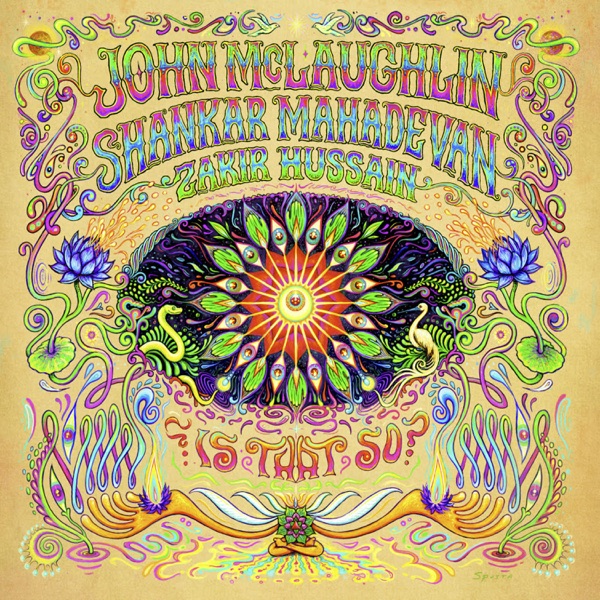
His next major shift came with Shakti, the acoustic group he formed in the mid-1970s with Indian classical musicians including L. Shankar and Zakir Hussain. This was a genuine stylistic reinvention rather than a sidestep. McLaughlin played a specially modified acoustic guitar with scalloped frets to allow for the string bends and ornaments central to Carnatic music, and the results sound unlike anything else in his catalog — patient, conversational, deeply rooted in a tradition he had studied seriously. If the Mahavishnu Orchestra represents McLaughlin at maximum pressure, Shakti represents him listening.
Through the 1980s and beyond, he worked in a variety of formats: solo acoustic guitar concerts, a reunion of the Mahavishnu Orchestra, guitar trios with Paco de Lucía and Al Di Meola, and later projects that returned to electric jazz settings. The trio recordings with de Lucía and Di Meola, particularly Friday Night in San Francisco (1981), introduced a lot of listeners to the possibility of acoustic guitar played at electric speeds, and those records still sound remarkable for their spontaneity and mutual respect among three very different players.
What you notice across all of it is that McLaughlin plays guitar like someone who genuinely can't stop looking for new problems to solve. He isn't coasting on a signature sound the way many guitarists do once they find one that works. The downside is occasional unevenness — not every project lands with the same force — but the upside is a catalog that keeps surprising you the further in you go.