The Professor Who Played Free
Ken McIntyre doesn't get mentioned in the same breath as Ornette Coleman or Eric Dolphy, and that's mostly an accident of biography rather than a judgment on the music. He was there at the start of the 1960s free jazz moment, recording Looking Ahead (1960) with Dolphy on alto, flute, clarinet and bass clarinet — a record where the two reed players, who apparently never discussed their approach beforehand, turned out to share an obsession with wide interval leaps and melodies that twist sideways instead of running in straight lines. It's a genuinely strange, beautiful album, and it should have launched McIntyre into the same conversation as his more famous friend.
Instead he kept teaching. McIntyre had a master's degree before most working musicians had a high school diploma, and he eventually earned a doctorate and built an academic career, founding and chairing an African American studies department at SUNY Old Westbury. That's not a footnote — it shaped the music. His playing never has that desperate, prove-it energy you hear in a lot of free jazz from guys trying to out-skronk each other. McIntyre sounds like someone who thought deeply about intervals and folk melody and African and Caribbean rhythm, and who had the patience of a teacher explaining something he actually understood.
He also just played a lot of instruments well, which is rarer than it sounds. Alto was his main voice, but he moved through flute, oboe, bassoon and bass clarinet with real fluency, not as novelty doubling. Albums like Stone Blues (1960) and Way Way Out (1963) show a guy stretching the vocabulary of hard bop toward something more open without abandoning swing or blues feeling entirely — this isn't noise for noise's sake, it's melody that refuses to resolve the way you expect.
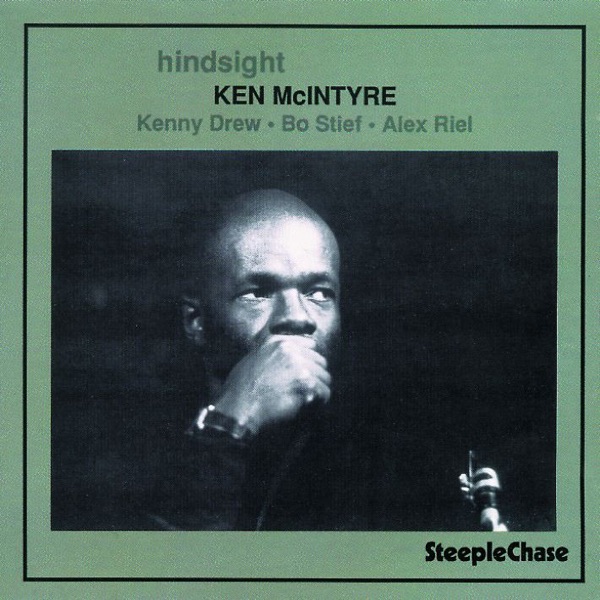
After a quiet stretch through much of the 1960s and 70s spent largely in academia, McIntyre found a second recording life with the Danish label SteepleChase, cutting records like Home (1975) that let him dig back into the same intervallic, folk-inflected language with players like Cecil McBee on bass. He kept at it into the 1990s, long after the spotlight had moved elsewhere. If you want an entry point into what free jazz sounded like when it still had one foot in melody and blues, McIntyre is a better place to start than people give him credit for.