Where do you listen?
Choose your streaming service
inside the sleeve
Loading…
inside the sleeveITS
⌕
Read About
Vocals - USA - Bebop / Swing

Carmen
McRae

Start here Carmen Sings Monk (1990) →
1922 - 1994, New York, USA

Carmen McRae was one of the great jazz singers, and she'd probably be the first to tell you she didn't get the credit she deserved. She sang like she was thinking out loud — every lyric dissected, every word placed exactly where she wanted it. What she did with a song was less about beauty and more about truth.

BebopSwingVocal Jazz
Carmen McRae

She Meant Every Word

Carmen grew up in Harlem and came up in the bebop era, which shaped everything about how she approached a song. She wasn't just a singer who happened to like bebop — she understood the music harmonically in a way most vocalists didn't, because she could play piano. That's not a throwaway detail. It meant she heard chord changes the way an instrumentalist does, and it showed. When she sang a melody, she knew exactly what was happening underneath it, and she'd push against it or lean into it accordingly.

Her style is sometimes described as cool or detached, but that's not quite right. She was controlled, sure, but there's a difference between cool and precise. McRae was precise. She could cut straight to the emotional center of a lyric without any of the theatrical embellishment that some of her contemporaries leaned on. She wasn't going to oversell you anything. If a song was sad, she'd let it be sad without telegraphing it from a mile away.

She worked with Denzil Best early on and was briefly married to him, which put her in the middle of the New York bebop scene at exactly the right moment. Thelonious Monk was a major influence — she recorded an entire album devoted to his compositions, Carmen Sings Monk (1990), which is one of the best things she ever did. Monk's tunes are notoriously difficult to sing because the melodies are so angular and the harmony so specific, but McRae handled them like she'd been waiting her whole life for the assignment.

Her recordings from the 1950s through the 1970s are remarkably consistent, which sounds like faint praise but isn't — a lot of singers from that era made records that haven't aged well, full of dated arrangements and glossy production. McRae's work holds up because her instrument was her intelligence as much as her voice. Albums like After Glow (1957) and The Great American Songbook (1972) show a singer who knew exactly what she was doing and had no interest in fads.

She never quite broke through to the mainstream celebrity level of Ella Fitzgerald or Sarah Vaughan, which is probably why she remains something of a singer's singer — the kind of artist that other vocalists reference constantly even if casual listeners don't always know her name. But spend a few hours with her records and you'll understand the devotion. She was serious about the music in a way that rewards serious listening.

Facts
BornApril 8, 1922, New York City, USA
DiedNovember 10, 1994, Beverly Hills, USA
InstrumentVocals, Piano
Active1940s – 1994
Known forIntellectually precise phrasing, bebop vocabulary applied to vocal jazz, Thelonious Monk interpretations
Connections
Thelonious MonkMajor influence, New York
→
Sarah VaughanContemporary and peer, New York
→
Ella FitzgeraldContemporary, New York
→
Read more

Discography

44 records
Carmen McRae
Carmen McRae
1955
A Foggy Day With Carmen McRae
1955
Torchy
Torchy
1955
By Special Request
By Special Request
1956
Blue Moon
Blue Moon
1956
After Glow
After Glow
1957
Boy Meets Girl
Boy Meets Girl
1957
Carmen for Cool Ones
1958
Birds of a Feather
Birds of a Feather
1958
When You're Away
When You're Away
1959
Book of Ballads
Book of Ballads
1959
♫
Tonight Only!
1960
Something to Swing About
1960
♫
Mad About the Man: Carmen McRae Sings Noel Coward
1961
♫
Take Five at Basin Street East
1961
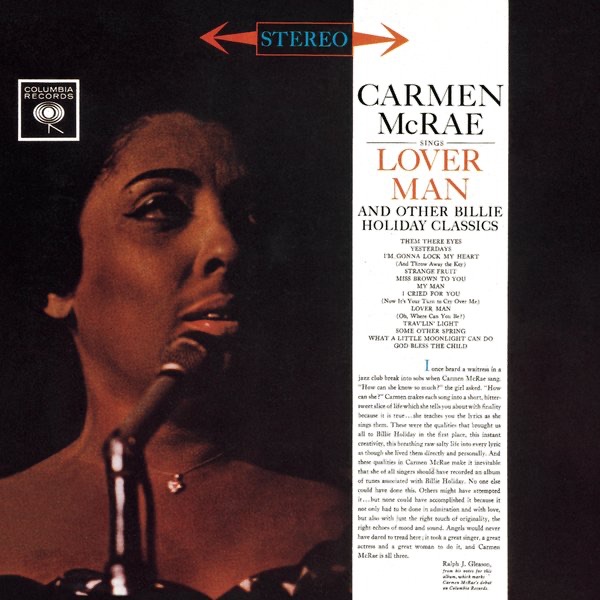
Sings Lover Man and Other Billie Holiday Classics
1962
♫
Something Wonderful
1963
Woman Talk: Live at the Village Gate
1966
For Once in My Life
For Once in My Life
1967
"Live" & Wailing
"Live" & Wailing
1968
The Sound of Silence
1968
Portrait of Carmen
Portrait of Carmen
1968
♫
Live at Century Plaza
1968
Just a Little Lovin’
1970
The Great American Songbook
1972
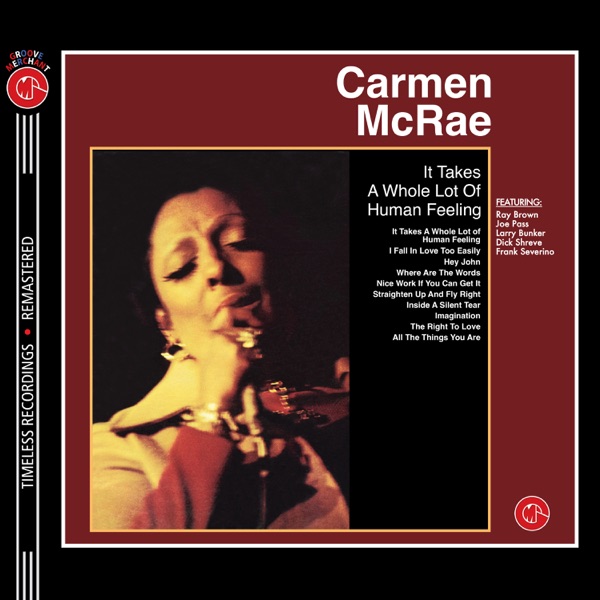
It Takes a Whole Lot of Human Feeling
1973
♫
As Time Goes By: Carmen McRae Alone Live at the Dug
1974
Ms. Jazz
Ms. Jazz
1974
November Girl
November Girl
1975
I Am Music
I Am Music
1975
Can't Hide Love
Can't Hide Love
1976
Ronnie Scott's Presents Carmen McRae 'Live'
1977
I'm Coming Home Again
1980
Heat Wave
Heat Wave
1982
Ms Magic
Ms Magic
1982
Any Old Time
Any Old Time
1986
The Carmen McRae and Betty Carter Duets
1987
At Ratso's, Volume 2
1987
Live at Bubba's
Live at Bubba's
1988
♫
Fine and Mellow (live at Birdland West)
1988
Dream of Life
Dream of Life
1989
Carmen Sings Monk
Carmen Sings Monk
1990
Here to Stay
Here to Stay
1992
For Lady Day, Volume 1
1995

Collaborations

Live on Youtube

Explore Further

Selected connections
Vocalist, USA
Sarah Vaughan
If McRae's precision appeals to you, Vaughan offers a different angle — more vocal acrobatics, but the same deep bebop roots. Comparing the two is one of the more rewarding exercises in vocal jazz.
Explore →
Album, 1990
Carmen Sings Monk
The clearest statement of what made McRae special. Monk's compositions are a minefield for most singers, but she navigates every odd angle without breaking a sweat.
Explore →

Who's playing
Listen next
Recording Info
Track listing
Musicians
Further Reading
Read more

Where next?

More by this artist

Albums with the same musicians

From the same era

Similar artists

inside the sleeve
Growing
Jazz, explained without pretension.
Read · Follow the connections · Press play
Right now: 7,100+ albums · 440+ artists
Start here
New to jazz? These artists are good places to start.
Loading…
Explore
Nine records worth getting lost in.
Born today
Album of the day
A landmark record, every day.
Read
  • Loading…
Article archive →
Recently added
Purpose
Inside the Sleeve is your companion on a journey through jazz — not a textbook, but something closer to a knowledgeable friend sitting next to you while you listen. Read about an artist, press play, follow a connection, discover an album you didn't know you needed.
Suggestions
Read

Articles

Essays, guides, and lists about jazz and the records that matter.

Loading…

Genre

Key Artists
Further Reading

Essential Albums

Related Genres

In This Genre

About

Inside the Sleeve

Work in progress

Inside the Sleeve grows continuously — new artists and albums are added, essays refined, as visitors explore and our editors follow up on what they find. Content, features, and design are still evolving; use the Report error button on any page to flag something that seems off.

Content

Every artist, album, and release date on Inside the Sleeve is real — verified against trusted sources including MusicBrainz and Wikipedia. We don't invent discographies or fabricate records. AI compiles that verified information into readable prose — essays on artists, albums, and the music itself. We can't manually review every essay before publishing, but every reported error is checked by a human editor.

Inside the Sleeve is not a review site. We're not here to rate or rank — we're here to guide you in. Where an album stands out, we'll say so. Where an artist changed everything, you'll know why. But we won't tear anything down. Jazz history is complex and sources sometimes disagree — if you spot something that seems off, please report it.

Streaming

Inside the Sleeve links to Spotify and Apple Music so you can listen while you read. These are not affiliate links. For Spotify, links open a search on open.spotify.com — we do not have direct links to specific recordings. For Apple Music, direct links are used where available, otherwise a search is opened.

Your choice of streaming service is stored locally in your browser only. It is never sent to our servers.

We're working on deeper Spotify integration, including direct links to specific recordings.

Privacy

Inside the Sleeve does not collect personal data and does not use cookies. We count page visits anonymously using a self-hosted analytics tool — no personal identifiers are stored, and the data never leaves our own server. The only preference stored on your device is your streaming service choice, saved locally in your browser and never transmitted.

When you submit a suggestion or error report, the text you write is stored in our database. No name or email is required or collected unless you choose to provide one.

Third-party services

Spotify and Apple Music are independent services with their own terms of use and privacy policies. Inside the Sleeve is not affiliated with or endorsed by either company.

Support

Inside the Sleeve is free and ad-free. If you enjoy it, a coffee helps cover server costs and keeps the project going.

Amazon

Some book recommendations on Inside the Sleeve link to Amazon. Buying through these links costs you nothing extra — but Amazon pays us a small commission, which goes directly towards keeping the site running. It's a simple way to support the project if you were going to buy the book anyway.
As an Amazon Associate, Inside the Sleeve earns from qualifying purchases.

Questions or feedback? Use the suggestion box on the front page.

Inside the Sleeve — A guide for those who want to go beyond the obvious About & Privacy