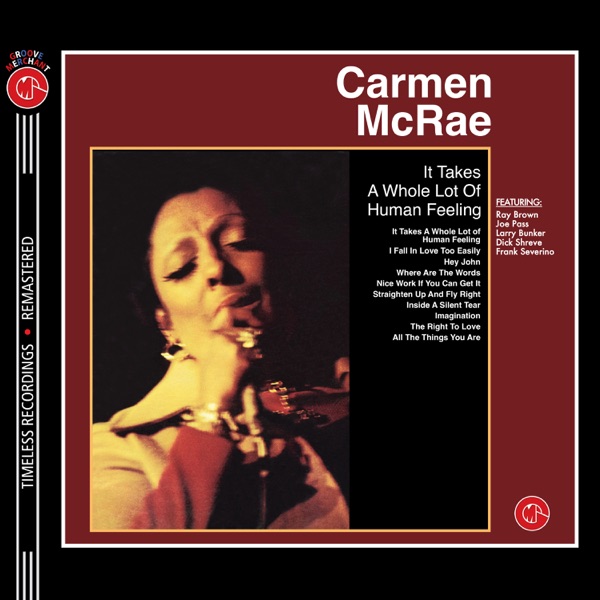
1973 · Album
It Takes a Whole Lot of Human Feeling
Recorded 1973 · Groove Merchant · Produced by Unknown
Carmen McRae's Human Feeling in 1973
McRae brings her sharp intelligence to material that deserved better songs, and mostly wins.
It Takes a Whole Lot of Human Feeling catches Carmen McRae in 1973, working for Groove Merchant, a label focused on jazz and soul crossover material. The title track comes from the 1971 musical Don't Bother Me, I Can't Cope, which means McRae is reaching into contemporary Broadway territory rather than standard jazz repertoire. That tells you something about where she was positioning herself at this point in her career — not chasing the past, willing to engage with new songwriting, even if the material wasn't always top-tier.
McRae's gift was always her directness. She didn't oversing, didn't add unnecessary flourishes, and didn't pretend a weak song was something it wasn't. That approach works in her favor here. The album functions as solid mid-seventies soul-jazz, the kind of thing that played well in clubs and on urban radio. She has good musicians around her, and the arrangements give her room to work without drowning her voice in strings or studio effects. Nothing here is revelatory, but nothing embarrasses her either. She sounds engaged, present, genuinely interested in what she's singing.
If you're new to McRae, this isn't the album to start with — you want her earlier work for the essentials. But if you know her already and want to see what she was doing in the early seventies, when jazz singers were navigating the shift toward soul and funk, this is a reasonable place to look. It's not her best, but it shows an artist who hadn't stopped paying attention to what was happening in music. That counts for something.
Who's playing
Where next?
More by Carmen McRae

Live at Bubba's 1988

By Special Request 1956
♫
Take Five at Basin Street East 1961

Carmen Sings Monk 1990
The musicians on this record
Their own records, close in time