The Horn That Changed Everything
Before Armstrong, jazz improvisation was largely a group conversation — horns weaving around each other, nobody really stepping forward. When he joined King Oliver's Creole Jazz Band in Chicago in the early 1920s, he was already bending that model. By the time he made the Hot Five and Hot Seven recordings between 1925 and 1928, the rules had changed permanently. Those sessions — recorded in Chicago for Okeh Records with a rotating cast that included Kid Ory and Earl Hines — document a musician doing something genuinely new: building long, arching solos that had shape, drama, and a logic you could follow like a story.
The sound itself is worth describing before you press play. His tone is full and round, not cutting or sharp the way some players of his era could be. He plays in the upper register with an ease that sounds almost casual, though any trumpet player will tell you it is anything but. And his timing — the way he floats behind or ahead of the beat — gives his lines a conversational looseness that feels completely relaxed even when the technical demand is enormous. Listen to his solo on West End Blues (1928) and you'll understand immediately. The opening cadenza, played unaccompanied, is one of the most recorded thirty seconds in jazz history, and it still sounds fresh.
His voice is inseparable from his trumpet playing. He scat sang the way he soloed — improvising melodic shapes, using syllables as texture, treating the human voice as another horn. When he sang lyrics, he bent them, delayed them, found the emotional core of a line and sat on it. He wasn't a crooner or a balladeer in the conventional sense. Even on sentimental material, there's a heft to his delivery, a weight in the chest that reminds you this was a man who'd worked hard his whole life.
The later Armstrong — from the late 1940s onward with the All Stars — is where opinion splits. The All Stars was a small group he toured with relentlessly for over two decades, playing stadiums and concert halls and State Department tours around the world. Critics at the time sometimes dismissed this period as commercial and repetitive, and it's true that the sets were consistent and crowd-pleasing rather than exploratory. But the recordings from these years, when you hear them in full, still contain moments of extraordinary playing. He hadn't lost the gift — he was just deploying it differently, for different audiences and different purposes. Hello, Dolly! (1964) hitting number one and knocking the Beatles off the top of the charts is often cited as a curiosity, but it's also just a great record — joyful, warm, alive.
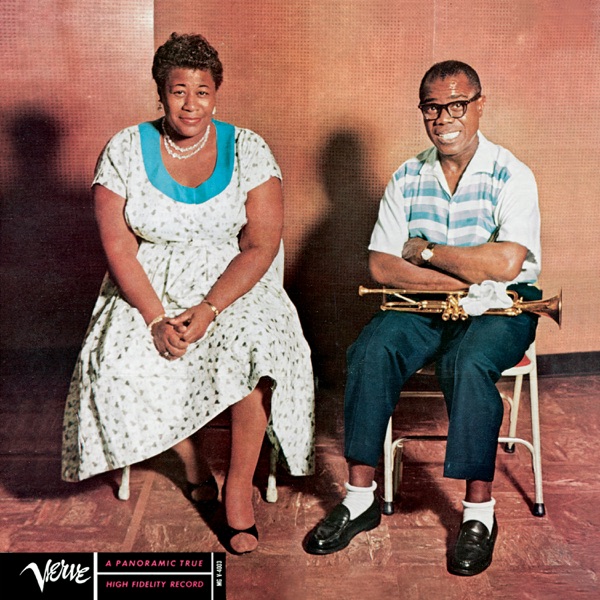
If you're coming to Armstrong fresh, start with the Hot Fives and Sevens. Then move to Ella and Louis (1956), his duo recordings with Ella Fitzgerald — intimate, loose, two masters genuinely enjoying each other's company. From there you can work backwards into New Orleans roots or forward into his later popular work. The discography is enormous and uneven, as fifty years of constant recording will produce, but the peaks are so high and so numerous that you'll keep finding things to return to.