1956 · Album
Ella and Louis
Recorded 1956 · Verve Records · Produced by Norman Granz
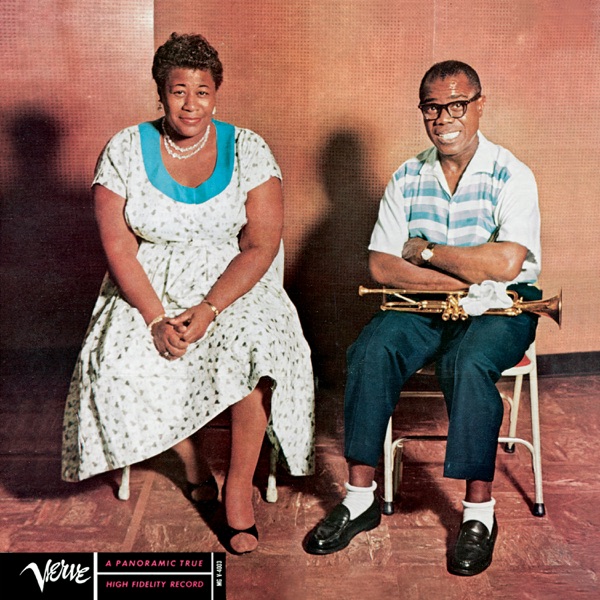
Two Voices, One Perfect Conversation
Fitzgerald and Armstrong together sound less like a recording and more like an evening you wish you'd been at.
When Ella Fitzgerald and Louis Armstrong made this record in 1956, they already had history together — collaborations going back to the late 1940s on Decca. So by the time they walked into the studio for Verve, there was no awkwardness to work through. You can hear that immediately. The whole album has the relaxed, unhurried quality of two people who genuinely enjoy each other's company, and that is not nothing. Backed by the Oscar Peterson Quartet, they move through a set of American standards with a lightness that never tips into laziness.
What actually makes this album work is the contrast between the two voices. Fitzgerald is precise and warm, her pitch immaculate. Armstrong is rougher, raspier, and somehow that roughness makes her sound even more polished by comparison — and vice versa. On tracks like "Isn't This a Lovely Day" and "The Nearness of You," the back-and-forth between them feels genuinely playful rather than staged. Peterson's quartet does exactly what you want a rhythm section to do here: it stays out of the way and keeps things swinging without ever calling attention to itself. That's harder than it sounds.
This was the first of three albums Fitzgerald and Armstrong would make together for Verve, followed by Ella and Louis Again (1957) and Porgy and Bess (1959). Of the three, this debut is the loosest and probably the most fun. It is not a challenging listen — nobody is pushing boundaries or reinventing anything. What it is, is a very good record of two exceptional singers doing what they do best, clearly enjoying themselves. If you want a single album that captures what made both of these artists lovable rather than just technically impressive, this is a strong candidate.
Who's playing
Where next?
More by Ella Fitzgerald

Wishes You a Swinging Christmas 1960

Ella Fitzgerald Sings the Rodgers and Hart Song Book 1956

Ella And Louis Again 1957

Ella Fitzgerald Sings the Duke Ellington Song Book 1957
The musicians on this record

Big Swing Face 1967
Buddy Rich
plays drums (drum set) here
plays drums (drum set) here

Ben Webster Meets Oscar Peterson 1959
Oscar Peterson
plays piano here
plays piano here

Satch Plays Fats: A Tribute to the Immortal Fats Waller 1955
Louis Armstrong
plays trumpet here
plays trumpet here

Bass Hit! 1957
Ray Brown
plays double bass here
plays double bass here


