Where do you listen?
Choose your streaming service
inside the sleeve
Loading…
inside the sleeveITS
⌕
Read About

♫

Facts
Connections
Read more

Discography

Collaborations

Live on Youtube

Explore Further

Selected connections
1957 · Album

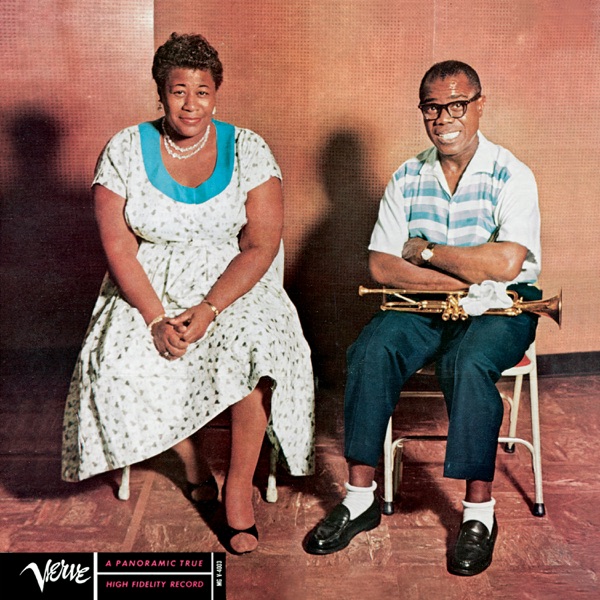
Ella And Louis Again

↑ Ella Fitzgerald

Recorded 1957 · Verve Records · Recording Locations: Radio Recorders and Capitol Studios, Hollywood
Ella And Louis Again

When Ella and Louis Found Their Groove Again

Their vocal rapport was so strong that Armstrong's absence from trumpet didn't matter as much as you'd think.

Ella and Louis Again picks up where Ella and Louis (1956) left off, but it's a different animal. The first album was all duets—Ella and Louis trading phrases, playing off each other's phrasing. This one loosens the formula. Seven tracks go solo, giving each of them room to breathe without the other. That might sound like a step backward, but it actually works. You get a clearer picture of what each singer brings to the table when they're not always in conversation.

The big change musically is Armstrong's trumpet. On the predecessor, he played on every track. Here he shows up on six. The Oscar Peterson Trio returns to back them, now joined by drummer Louie Bellson. That's a solid outfit—Peterson's always swinging, and Bellson keeps things moving. Alex Henderson, writing for AllMusic, nailed it: their vocal rapport is so strong that the trumpet shortage doesn't hurt. Armstrong still sounds like Armstrong whether he's blowing or singing, and Fitzgerald is Fitzgerald no matter what. The duo spends more time together than apart, which is where the real magic lives. When they're on the same track, there's an ease between them that feels earned, not forced.

This isn't the album that changed jazz or anything like that. It's a solid professional job by two singers who knew exactly what they were doing. If you've heard the first Ella and Louis record and want more of that chemistry, this delivers. It's comfortable, well-played, and frankly worth your time. Not every jazz album needs to be a landmark. Sometimes you just want to hear two great singers who like each other, backed by musicians who can keep up.

Who's playing
Ray Browndouble bass
Oscar Petersonpiano
Herb Ellisguitar
Louis Armstrongtrumpet
Louie Bellsondrums
Listen next
By Ella Fitzgerald
Wishes You a Swinging Christmas 1960
Oscar Peterson's own record
Ben Webster Meets Oscar Peterson 1959
Oscar Peterson plays piano here
More Swing
After Midnight 1956
Nat King Cole
Recording Info
Track listing
1Don't Be That Way
2Makin' Whoopee
3They All Laughed
4Comes Love
5Autumn In New York
6Let's Do It (Let's Fall In Love)
7Stompin' At The Savoy
8I Won't Dance
9Gee Baby Ain't I Good To You
Musicians
Further Reading
Read more

Where next?

More by Ella Fitzgerald
Wishes You a Swinging Christmas 1960
Ella and Louis 1956
Ella Fitzgerald Sings the Rodgers and Hart Song Book 1956
Ella Fitzgerald Sings the Duke Ellington Song Book 1957
All 24 albums →
The musicians on this record
Ben Webster Meets Oscar Peterson 1959
Oscar Peterson
plays piano here
Louis Armstrong Meets Oscar Peterson 1957
Louis Armstrong
plays trumpet here
Cannonball Adderley and the Poll-Winners 1960
Ray Brown
plays double bass here
Herb Ellis Meets Jimmy Giuffre 1959
Herb Ellis
plays guitar here
Their own records, close in time
More Swing
After Midnight 1956
Nat King Cole
Songs for Swingin’ Lovers! 1956
Frank Sinatra
Jazz Alive! A Night at the Half Note 1959
Al Cohn
Coleman Hawkins encounters Ben Webster 1959
Ben Webster
All 94 Swing artists →

More by this artist

Albums with the same musicians

From the same era

Similar artists

inside the sleeve
Growing
Jazz, explained without pretension.
Read · Follow the connections · Press play
Right now: 7,100+ albums · 440+ artists
Start here
New to jazz? These artists are good places to start.
Loading…
Explore
Nine records worth getting lost in.
Born today
Album of the day
A landmark record, every day.
Read
  • Loading…
Article archive →
Recently added
Purpose
Inside the Sleeve is your companion on a journey through jazz — not a textbook, but something closer to a knowledgeable friend sitting next to you while you listen. Read about an artist, press play, follow a connection, discover an album you didn't know you needed.
Suggestions
Read

Articles

Essays, guides, and lists about jazz and the records that matter.

Loading…

Genre

Key Artists
Further Reading

Essential Albums

Related Genres

In This Genre

About

Inside the Sleeve

Work in progress

Inside the Sleeve grows continuously — new artists and albums are added, essays refined, as visitors explore and our editors follow up on what they find. Content, features, and design are still evolving; use the Report error button on any page to flag something that seems off.

Content

Every artist, album, and release date on Inside the Sleeve is real — verified against trusted sources including MusicBrainz and Wikipedia. We don't invent discographies or fabricate records. AI compiles that verified information into readable prose — essays on artists, albums, and the music itself. We can't manually review every essay before publishing, but every reported error is checked by a human editor.

Inside the Sleeve is not a review site. We're not here to rate or rank — we're here to guide you in. Where an album stands out, we'll say so. Where an artist changed everything, you'll know why. But we won't tear anything down. Jazz history is complex and sources sometimes disagree — if you spot something that seems off, please report it.

Streaming

Inside the Sleeve links to Spotify and Apple Music so you can listen while you read. These are not affiliate links. For Spotify, links open a search on open.spotify.com — we do not have direct links to specific recordings. For Apple Music, direct links are used where available, otherwise a search is opened.

Your choice of streaming service is stored locally in your browser only. It is never sent to our servers.

We're working on deeper Spotify integration, including direct links to specific recordings.

Privacy

Inside the Sleeve does not collect personal data and does not use cookies. We count page visits anonymously using a self-hosted analytics tool — no personal identifiers are stored, and the data never leaves our own server. The only preference stored on your device is your streaming service choice, saved locally in your browser and never transmitted.

When you submit a suggestion or error report, the text you write is stored in our database. No name or email is required or collected unless you choose to provide one.

Third-party services

Spotify and Apple Music are independent services with their own terms of use and privacy policies. Inside the Sleeve is not affiliated with or endorsed by either company.

Support

Inside the Sleeve is free and ad-free. If you enjoy it, a coffee helps cover server costs and keeps the project going.

Amazon

Some book recommendations on Inside the Sleeve link to Amazon. Buying through these links costs you nothing extra — but Amazon pays us a small commission, which goes directly towards keeping the site running. It's a simple way to support the project if you were going to buy the book anyway.

As an Amazon Associate, Inside the Sleeve earns from qualifying purchases.

Questions or feedback? Use the suggestion box on the front page.

Inside the Sleeve — A guide for those who want to go beyond the obvious About & Privacy