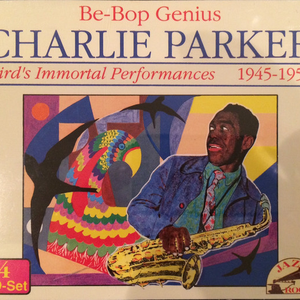
The Speed of a New Language
Charlie Parker grew up in Kansas City, Missouri, at a moment when the city was a crossroads of American music — a wide-open town with a nightlife that never stopped and a blues tradition that ran bone-deep. He was a mediocre student of music by conventional measures at first, famously laughed off the bandstand by drummer Jo Jones at a jam session. But Parker was listening harder than anyone realized, woodshedding obsessively, absorbing the chord changes of popular songs and then bending them until they became something else entirely — something that wasn't swing, wasn't blues, wasn't anything with a name yet.
By the early 1940s, Parker had found his people in New York: Dizzy Gillespie, Thelonious Monk, Kenny Clarke, and the young Miles Davis, among others. Together, in after-hours sessions at Minton's Playhouse in Harlem, they were building bebop — a music deliberately designed to be hard to copy and impossible to dance to in a ballroom, a music that said jazz was serious art that required your full attention, not background music for the floor. Parker's thing was the harmony: he improvised on the chord changes rather than the melody, threw in substitute chords, played in the upper parts of harmonies that nobody had thought to use as melody before.
His recordings with small groups in the mid-to-late 1940s are still the ones musicians study. The 1945 Savoy session that gave us 'Ko-Ko' — built on the changes to 'Cherokee,' the song that had beaten him up as a teenager — feels like a full circle moment. His lines at crazy-fast speeds weren't just quick; they made sense structurally, they had real feeling behind them, and he threw in quotes from classical music to nursery rhymes. His alto saxophone tone was sharp and almost human, somewhere between a wail and a laugh, and nobody's really matched it.
Parker's personal life was a mess that kept dragging at him. Heroin — which started when he was a kid — cost him his Cabaret Card, his relationships, recording work, and finally his health. He ended up at Camarillo State Hospital in 1946 after a breakdown in Los Angeles. The time he stayed clean after that gave him some of his best sessions, including the Dial recordings that produced 'Relaxin' at Camarillo.' But he couldn't hold onto it. His last years were rough — missed gigs, unpredictable behavior, his body giving out.
He died on March 12, 1955, in the apartment of the Baroness Pannonica de Koenigswarter — a jazz fan who took in musicians who needed help — while watching television. He was thirty-four, and the doctor said his body looked like it belonged to a man in his sixties. Within days, 'Bird Lives' started showing up as graffiti all over New York. It wasn't just wishful thinking. The harmonic and melodic language Parker invented became how modern jazz speaks, a foundation so completely built into the music that even musicians who never heard his name play in the world he created.