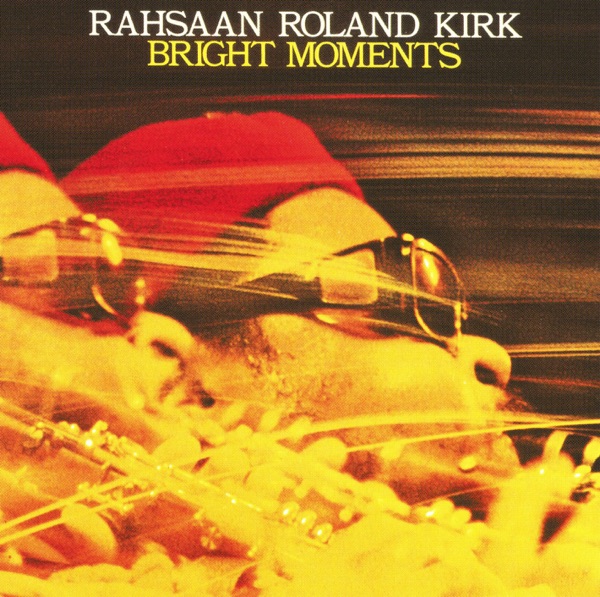
1973 · Album
Bright Moments
Recorded June 1973, Keystone Korner, San Francisco · Atlantic · Produced by Not credited
Kirk Live: The Room as Instrument
Kirk fed voraciously off the energy of the room, turning a club gig into a masterclass in joy and reach.
By the early 1970s, Rahsaan Roland Kirk had already spent a decade as one of jazz's most distinctive voices—a multi-instrumentalist who played tenor saxophone, stritch, and manzello simultaneously, who treated the stage like a playground, and who refused to accept that jazz had to be serious to be profound. Bright Moments (1974) is not a turning point in his career so much as a crystallization: the album where his live energy, his restless musicality, and his gift for drawing audiences into his world all come together on record in a way his studio work often couldn't quite capture.
Recorded at Keystone Korner in San Francisco in June 1973, this double album is essentially Kirk doing what he lived for—performing in front of people, talking them through his ideas, moving between bebop and blues and spiritual searching without apology. He's surrounded by a tight rhythm section and collaborators who understand the assignment: Ron Burton, Henry Mattathias Pearson, and Joe Texidor lock in behind him, giving Kirk the space to riff, digress, and riff again. The long intros, the between-song patter, the leaps from straight-ahead blowing to near-comedic asides—all of it works here because Huey's point stands: Kirk's extroversion was never a mask. He genuinely believed in music as conversation, as energy exchange, as something that happened in real time with real people listening.
AllMusic reviewer Steve Huey called it his greatest album of the '70s, and the case is strong. Bright Moments doesn't sound like Kirk trying to prove anything. It sounds like Kirk being completely himself, which by then meant being a force of nature. If you want to understand what made him matter, this is the place to start.