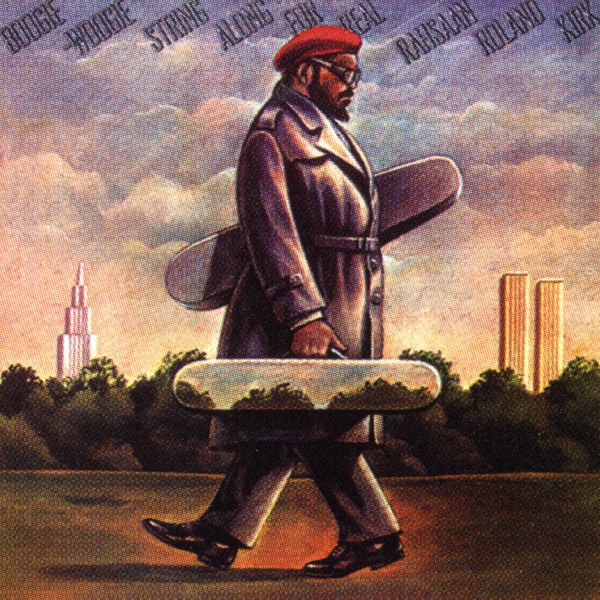
Kirk's Final Strings: Defiance After Stroke
Recorded after a stroke left him partially paralyzed, Kirk refused to retreat into silence.
Rahsaan Roland Kirk came to Boogie-Woogie String Along for Real in 1978 as a man working against his own body. A stroke had partially paralyzed him, an outcome that might have ended most careers. Instead, he assembled a full string section and orchestra—violins, violas, cellos, French horn—alongside a tight rhythm unit anchored by Sammy Price on piano and a rotation of drummers. The session itself was an act of will. Kirk on tenor saxophone, supported by Eddie Preston on trumpet and Steve Turre on trombone, had to navigate arrangements that asked him to lead through an ensemble of considerable size. This was not his usual territory. Kirk had built his reputation in trios and small groups, moving through horns with physical virtuosity and unpredictable harmonic imagination. Here, he was constrained and supported simultaneously—the strings provided architecture, but they also demanded he stay in place.
The music doesn't always convince. AllMusic rated it 3.5/5, and that's fair: some arrangements feel stiff, and Kirk's voice, though unmistakable, doesn't dominate the way it does in his lean, hungry small-group records. But the listening experience is inseparable from its context. This is Kirk refusing to disappear. Tiny Grimes on guitar, Phil Bowler and Arvell Shaw on bass, the full string weight—they're all there because Kirk wanted to keep playing. The record wobbles sometimes, reaches beyond what it quite pulls off, but it's never timid. That matters.
Who's playing
Phil Bowlerbass
Arvell Shawbass
William S. Fischerelectric piano
Sammy Pricepiano
Tiny Grimesguitar
Rahsaan Roland Kirktenor saxophone
Eddie Prestontrumpet
Steve Turretrombone
Kenneth Harrisflute
Sonny Browndrums
Gifford McDonalddrums
Jonathan Abramowitzcello
Sanford Allenviolin
Julien Barberviola
Jim BuffingtonFrench horn
Doreen Callenderviolin
Selwart Clarkeviola
Charles Fambroughcello
Regis Iandiorioviolin
Kathryn Kienkeviolin
Harold Kohonviolin
Linda Lawrenceviola
Yoko Matsuoviolin
Eugene J. Moyecello
Tony Poskviolin
Percy Heathcello
Hilton Ruizkeyboard