Where do you listen?
Choose your streaming service
inside the sleeve
Loading…
inside the sleeveITS
⌕
Read About
Vibraphone · USA · Jazz-Funk / Soul-Jazz

Roy
Ayers

Start here Everybody Loves The Sunshine (1976) →
1940 - present, Los Angeles, USA

Roy Ayers is the rare musician who built a loyal following in two completely different worlds — jazz and funk — and never really had to choose between them. Starting as a hard bop vibraphonist in the 1960s, he gradually developed a warm, groove-centered sound that became one of the most sampled catalogs in hip-hop history. He didn't abandon jazz for pop; he just followed his ear somewhere irresistibly funky.

Jazz FusionSoul Jazz
Roy Ayers

Everybody Loves the Vibes

Ayers grew up in Los Angeles, where his mother played piano and a young Lionel Hampton reportedly gave him a pair of mallets as a kid. That detail feels almost too perfect, but it tracks — there's a directness and a physical joy in Ayers's playing that suggests someone who fell in love with the instrument early and never lost that feeling. By his late twenties he was recording hard bop sessions and working with Herbie Mann, sharpening his chops in a more conventional jazz context before he figured out exactly what he wanted to say.

What he wanted to say turned out to involve a lot of Rhodes piano, wah-wah guitar, and a groove that sat somewhere between a jazz club and a dance floor. His group Ubiquity, formed in the early 1970s, became the vehicle for this sound, and the records he made on Polydor during that decade — Mystic Voyage (1975), Everybody Loves the Sunshine (1976), Vibrations (1976) — are the ones that made him a legend. The vibraphone, which can sound icy or academic in the wrong hands, rings warm and almost vocal in his. He plays simply, melodically, with a light touch that never shows off.

The title track from Everybody Loves the Sunshine (1976) is probably his most famous composition, and it's a good entry point precisely because it asks so little of you. It's a short, gentle meditation — barely a song in the conventional sense — that just floats. That quality runs through a lot of his best work: he's not trying to dazzle you with complexity, he's trying to put you somewhere. Whether that somewhere counts as jazz is a question that bothered critics more than it ever seemed to bother him.

The hip-hop world discovered him in a big way during the late 1980s and 1990s. Producers from A Tribe Called Quest to Mary J. Blige to Foxy Brown dug into his catalog, and suddenly a generation of listeners who had never set foot in a jazz club knew his melodic signatures intimately without necessarily knowing his name. That's a strange kind of immortality, but it also reflects something genuine about his music — those loops work because the originals were already built around feel and repetition, not just chord changes.

Ayers continued performing and recording well into his later decades, a living connection between the soul-jazz era and everything it seeded. He's not a figure who revolutionized the vibraphone the way Gary Burton or Bobby Hutcherson pushed the instrument's harmonic possibilities — his contribution is more about mood, accessibility, and a specific Californian warmth that turned out to have very long legs. If you're coming to him fresh, start with the Polydor run. Give it time to settle. It rewards patience and a relaxed room.

Facts
BornSeptember 10, 1940, Los Angeles, California, USA
InstrumentVibraphone
Active1960s – present
Known forSoul-jazz and jazz-funk recordings of the 1970s; one of the most sampled catalogs in hip-hop history
Connections
Herbie MannCollaborator / Bandleader, New York
→
Bobby HutchersonContemporary vibraphonist, San Francisco
→
Gary BurtonContemporary vibraphonist, Boston
→
Read more
GenreJazz funk: how jazz learned to make you move

Discography

10 records
Stoned Soul Picnic
Stoned Soul Picnic
1968
Ubiquity
Ubiquity
1970
Coffy
Coffy
1973
Mystic Voyage
Mystic Voyage
1975
Everybody Loves The Sunshine
1976
Vibrations
Vibrations
1983
Mahogany Vibe
Mahogany Vibe
2004
Red, Black & Green
Red, Black & Green
A Shining Symbol
A Shining Symbol
Virgin Ubiquity II
Virgin Ubiquity II

Collaborations

Live on Youtube

Explore Further

Selected connections
Vibraphonist, USA
Bobby Hutcherson
Where Ayers went warm and groovy, Hutcherson went deep and harmonically adventurous — the two together define the full range of what the vibraphone could do in this era.
Explore →
Album, 1975
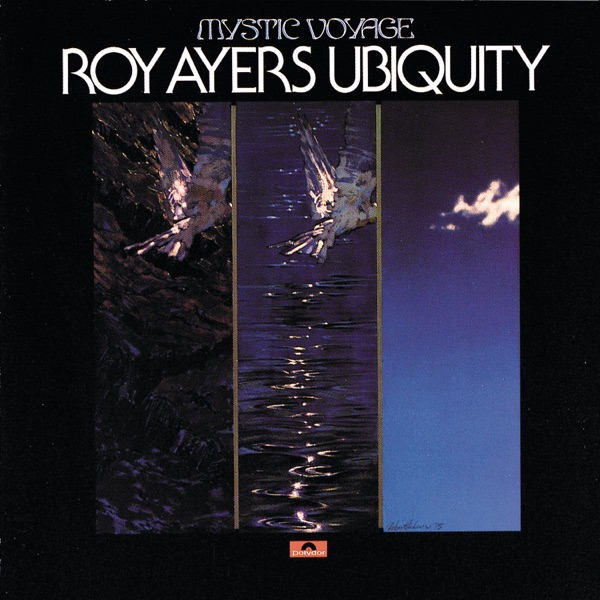
Mystic Voyage
One of Ayers's most cohesive Polydor records, balancing spiritual jazz energy with the irresistible funk pocket his group Ubiquity had fully locked in by this point.
Explore →

Who's playing
Listen next
Recording Info
Track listing
Musicians
Further Reading
Read more

Where next?

More by this artist

Albums with the same musicians

From the same era

Similar artists

inside the sleeve
Growing
Jazz, explained without pretension.
Read · Follow the connections · Press play
Right now: 7,100+ albums · 440+ artists
Start here
New to jazz? These artists are good places to start.
Loading…
Explore
Nine records worth getting lost in.
Born today
Album of the day
A landmark record, every day.
Read
  • Loading…
Article archive →
Recently added
Purpose
Inside the Sleeve is your companion on a journey through jazz — not a textbook, but something closer to a knowledgeable friend sitting next to you while you listen. Read about an artist, press play, follow a connection, discover an album you didn't know you needed.
Suggestions
Read

Articles

Essays, guides, and lists about jazz and the records that matter.

Loading…

Genre

Key Artists
Further Reading

Essential Albums

Related Genres

In This Genre

About

Inside the Sleeve

Work in progress

Inside the Sleeve grows continuously — new artists and albums are added, essays refined, as visitors explore and our editors follow up on what they find. Content, features, and design are still evolving; use the Report error button on any page to flag something that seems off.

Content

Every artist, album, and release date on Inside the Sleeve is real — verified against trusted sources including MusicBrainz and Wikipedia. We don't invent discographies or fabricate records. AI compiles that verified information into readable prose — essays on artists, albums, and the music itself. We can't manually review every essay before publishing, but every reported error is checked by a human editor.

Inside the Sleeve is not a review site. We're not here to rate or rank — we're here to guide you in. Where an album stands out, we'll say so. Where an artist changed everything, you'll know why. But we won't tear anything down. Jazz history is complex and sources sometimes disagree — if you spot something that seems off, please report it.

Streaming

Inside the Sleeve links to Spotify and Apple Music so you can listen while you read. These are not affiliate links. For Spotify, links open a search on open.spotify.com — we do not have direct links to specific recordings. For Apple Music, direct links are used where available, otherwise a search is opened.

Your choice of streaming service is stored locally in your browser only. It is never sent to our servers.

We're working on deeper Spotify integration, including direct links to specific recordings.

Privacy

Inside the Sleeve does not collect personal data and does not use cookies. We count page visits anonymously using a self-hosted analytics tool — no personal identifiers are stored, and the data never leaves our own server. The only preference stored on your device is your streaming service choice, saved locally in your browser and never transmitted.

When you submit a suggestion or error report, the text you write is stored in our database. No name or email is required or collected unless you choose to provide one.

Third-party services

Spotify and Apple Music are independent services with their own terms of use and privacy policies. Inside the Sleeve is not affiliated with or endorsed by either company.

Support

Inside the Sleeve is free and ad-free. If you enjoy it, a coffee helps cover server costs and keeps the project going.

Amazon

Some book recommendations on Inside the Sleeve link to Amazon. Buying through these links costs you nothing extra — but Amazon pays us a small commission, which goes directly towards keeping the site running. It's a simple way to support the project if you were going to buy the book anyway.

As an Amazon Associate, Inside the Sleeve earns from qualifying purchases.

Questions or feedback? Use the suggestion box on the front page.

Inside the Sleeve — A guide for those who want to go beyond the obvious About & Privacy