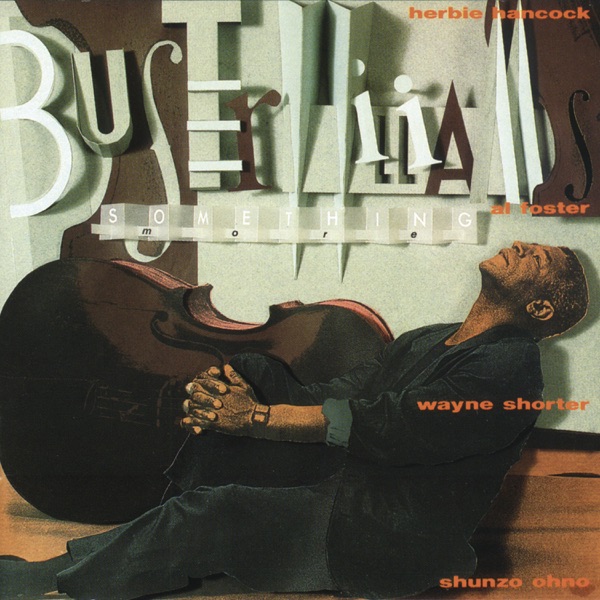
The Root That Holds
Buster Williams grew up around music — his father was a bassist, which gave him an early, practical understanding of the instrument as a living thing rather than a theory exercise. By his early twenties he was already working at a level that most players spend a lifetime trying to reach, and his time with Nancy Wilson and Betty Carter in the 1960s gave him a particular sensitivity to phrasing and space that stayed with him. He learned how to listen before he learned how to dominate, and that order of operations matters enormously in how he plays.
The recordings that cemented his reputation came when he joined Herbie Hancock's acoustic group in the late 1960s, a band that also included Wayne Shorter and Tony Williams. This was not a setting for passengers. The music moved fast and thought faster, and Williams held it together without ever sounding like he was holding anything back. His bass lines on Speak Like a Child (1968) and the sessions around that period have a melodic intelligence to them — he's not just keeping time, he's participating in the conversation, often redirecting it.
Through the 1970s he worked extensively with Ron Carter's circle and became a regular presence in Wynton Kelly's and later Mary Lou Williams's groups, as well as spending years with the Sphere quartet alongside Kenny Barron, Charlie Rouse, and Ben Riley. Sphere was formed in tribute to Thelonious Monk, and the group's approach — rigorous but never stiff, devoted to Monk's vocabulary without being trapped by it — suited Williams perfectly. He's always been someone who honors the tradition by playing it honestly rather than reverently.
As a leader, Williams has made records that reward patience. His own albums tend toward a lyrical, reflective quality — the kind of bass playing where you notice the arc of a phrase, the way a note is released, the silence between beats. He's never been a flashy player and seems uninterested in being one. What he's after is something closer to inevitability: the sense that this particular note, played this particular way, was the only real option.
What you take away from time spent with Buster Williams is a reminder that the bass is not furniture. In the wrong hands it's just a pulse; in his hands it's a perspective. He hears the whole band from the bottom up, and he shapes what he hears. That's a skill that doesn't photograph well and doesn't make headlines, but every musician who has shared a bandstand with him knows exactly what it's worth.