1963 · Album
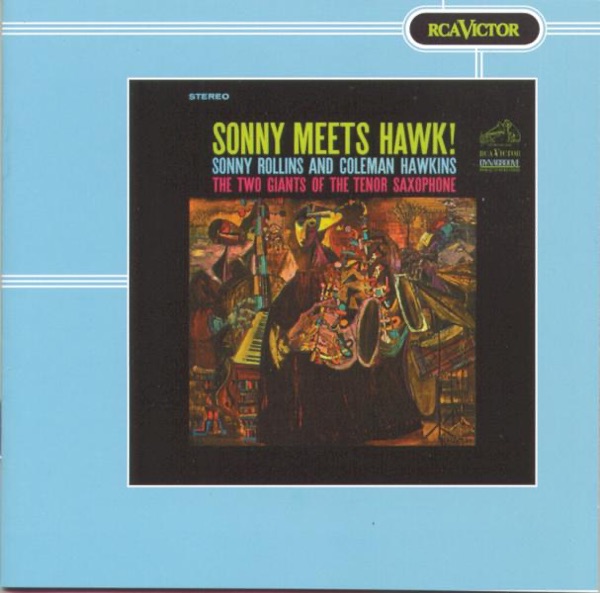
Sonny Meets Hawk!
Recorded July 15 and 18, 1963 · RCA Victor Studio B, New York City · RCA Victor
Two Tenors, One Moment of Risk
Rollins strips away safety and leans hard into the experimental—a sharp left turn at a pivotal moment.
By 1963, Sonny Rollins had already established himself as one of jazz's most inventive tenor players. He'd made his mark with hard-swinging records and lengthy, exploratory improvisations. But this session with Coleman Hawkins, recorded in July at RCA Victor Studio B, finds Rollins deliberately stepping away from what he did best. Instead of the muscular, bluesy tenor playing that defined his earlier work, he ventures into avant-garde territory—fractured phrases, angular melody, textures that sound almost unfinished. It's a sharp turn, and it matters because it shows Rollins thinking differently about what the saxophone could say.
Hawkins brings a different kind of authority to these sessions. By 1963, he was already a legend—the man who invented the tenor saxophone as a solo instrument. Bringing him into the room with Rollins created a natural tension: the old guard meeting a younger musician willing to break things on purpose. The album captures that collision without resolving it. Some tracks swing hard, others feel deliberately fractured. This isn't Rollins playing it safe or Hawkins playing it young. It's two strong voices occupying the same space without compromise.
For Rollins fans, this sits apart from his core catalog. It's not the entry point—that would be something like Saxophone Colossus (1956). This is a record for listeners who've already heard him swing and want to see what he sounded like when he decided to experiment. It didn't reshape his career or influence what came next, but it's a useful artifact: proof that Rollins was curious enough to take a real risk in the studio.
Who's playing
Bob Cranshawdouble bass
Henry Grimesdouble bass
Paul Bleypiano
Coleman Hawkinstenor saxophone
Sonny Rollinstenor saxophone
Roy McCurdydrums
Where next?
More by Coleman Hawkins

Duke Ellington Meets Coleman Hawkins 1963
♫
The Hawk Flies High 1957

Coleman Hawkins and Confrères
The Hawk Relaxes 1961
The musicians on this record
Their own records, close in time