Where do you listen?
Choose your streaming service
inside the sleeve
Loading…
inside the sleeveITS
⌕
Read About
Piano · France · Post-Bop

Michel
Petrucciani

Start here Michel Plays Petrucciani (1988) →
1962 – 1999, France

Michel Petrucciani played piano with a joy that was almost aggressive — like he was making a point about something. Born with osteogenesis imperfecta, a condition that left him under three feet tall and required him to be carried to the piano bench, he made music that had no trace of limitation in it. He died at 36, and the recordings he left behind still sound alive in a way that a lot of jazz from that era doesn't.

Post-Bop
Michel Petrucciani

Small Hands, Enormous Sound

The first thing worth knowing before you press play is that Petrucciani sounds like someone who genuinely loved playing piano — not in a showy way, but in the way where you can tell the music is actually making him happy while he's doing it. There's a warmth to his touch that's immediately recognizable. He came up listening to Bill Evans and Duke Ellington, and both of those influences are in there, but he processed them into something that sounds distinctly his own. His lines are melodic almost to a fault — he never gets so abstract that you lose the thread.

He grew up in Orange, in the south of France, playing in his family's band as a kid. His father and brothers were musicians, so he was immersed early. By his teens he was playing professionally, and by his early twenties he'd relocated to the United States, where he caught the attention of Charles Lloyd. Lloyd essentially brought him to American audiences, and the recordings they made together in the early 1980s are worth tracking down if you want to hear Petrucciani before he fully hit his stride as a leader.

His Blue Note recordings from the mid-to-late 1980s are where most people start, and that's reasonable. Trio in Tokyo (1999) catches him live and at full force, but Michel Plays Petrucciani (1988) is a good early entry point — it's a solo record that shows how much he could do without anyone else in the room. His compositions have strong, hummable themes, and he could stretch them out or compress them without losing the feeling of the original idea. That's harder than it sounds.

What he did harmonically was interesting but never alienating. He used extended chords and could be harmonically adventurous, but the music never became an exercise in complexity for its own sake. He wanted you to feel it. That makes him easier to recommend to people who are new to jazz piano, but it would be a mistake to think of him as simple — the craft underneath those appealing surfaces is serious. Musicians who played with him consistently talked about how much he could hear and how responsive he was in real time.

He died in New York in January 1999 from complications related to his condition. He was 36. The catalog he left — somewhere around two dozen albums as a leader — holds up well. He wasn't trying to reinvent the idiom or make some big statement. He was trying to play beautifully and make something people would want to listen to. He mostly succeeded.

Facts
BornDecember 28, 1962 · Orange, France
DiedJanuary 6, 1999 · New York, NY
InstrumentPiano
Active1970s – 1999
Known forLyrical post-bop piano, Blue Note recordings, solo and trio work
Connections
Charles LloydCollaborator and early champion, USA
→
Lee KonitzRecording partner, New York
→
Wayne ShorterCollaborator, New York
→
Read more

Discography

21 records
Conférence de presse, Volume 2
1960
Flash
Flash
1980
Michel Petrucciani
Michel Petrucciani
1981
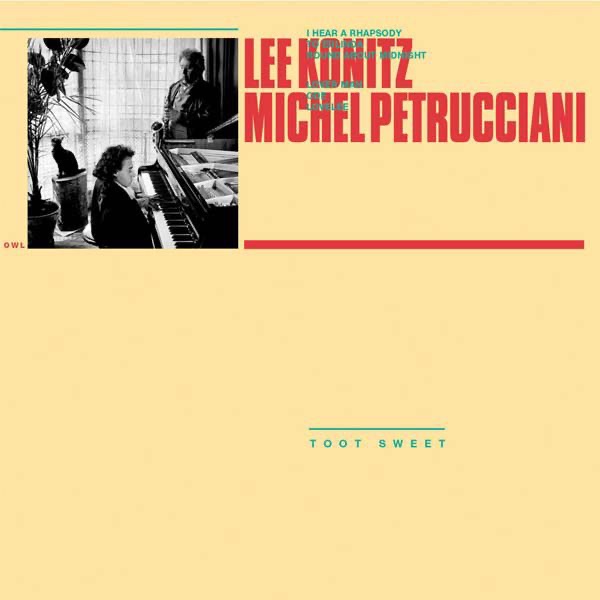
Toot Sweet
Toot Sweet
1982
Oracle’s Destiny
Oracle’s Destiny
1983
100 Hearts
100 Hearts
1984
Note ’n Notes
Note ’n Notes
1984
Cold Blues
Cold Blues
1985
Power of Three
Power of Three
1987
Michel Plays Petrucciani
1988
Music
Music
1989
Playground
Playground
1991
♫
Date With Time
1991
Promenade With Duke
Promenade With Duke
1993
Conférence de presse, Volume 1
1994
Petrucciani NHØP
Petrucciani NHØP
1994
Flamingo
Flamingo
1996
Both Worlds
Both Worlds
1997
Conversations With Michel
2000
Conversation
Conversation
2001
♫
Marvellous

Collaborations

Live on Youtube

Explore Further

Selected connections
Pianist, USA
Bill Evans
Petrucciani absorbed Evans deeply — the voicings, the introspective approach to ballads. Start with Evans if you want to hear the root of a lot of what Petrucciani did.
Explore →
Album, 1988
Michel Plays Petrucciani
A solo piano record that strips everything back and shows how strong his compositions and his touch actually were without a rhythm section to lean on.
Explore →

Who's playing
Listen next
Recording Info
Track listing
Musicians
Further Reading
Read more

Where next?

More by this artist

Albums with the same musicians

From the same era

Similar artists

inside the sleeve
Growing
Jazz, explained without pretension.
Read · Follow the connections · Press play
Right now: 7,100+ albums · 440+ artists
Start here
New to jazz? These artists are good places to start.
Loading…
Explore
Nine records worth getting lost in.
Born today
Album of the day
A landmark record, every day.
Read
  • Loading…
Article archive →
Recently added
Purpose
Inside the Sleeve is your companion on a journey through jazz — not a textbook, but something closer to a knowledgeable friend sitting next to you while you listen. Read about an artist, press play, follow a connection, discover an album you didn't know you needed.
Suggestions
Read

Articles

Essays, guides, and lists about jazz and the records that matter.

Loading…

Genre

Key Artists
Further Reading

Essential Albums

Related Genres

In This Genre

About

Inside the Sleeve

Work in progress

Inside the Sleeve grows continuously — new artists and albums are added, essays refined, as visitors explore and our editors follow up on what they find. Content, features, and design are still evolving; use the Report error button on any page to flag something that seems off.

Content

Every artist, album, and release date on Inside the Sleeve is real — verified against trusted sources including MusicBrainz and Wikipedia. We don't invent discographies or fabricate records. AI compiles that verified information into readable prose — essays on artists, albums, and the music itself. We can't manually review every essay before publishing, but every reported error is checked by a human editor.

Inside the Sleeve is not a review site. We're not here to rate or rank — we're here to guide you in. Where an album stands out, we'll say so. Where an artist changed everything, you'll know why. But we won't tear anything down. Jazz history is complex and sources sometimes disagree — if you spot something that seems off, please report it.

Streaming

Inside the Sleeve links to Spotify and Apple Music so you can listen while you read. These are not affiliate links. For Spotify, links open a search on open.spotify.com — we do not have direct links to specific recordings. For Apple Music, direct links are used where available, otherwise a search is opened.

Your choice of streaming service is stored locally in your browser only. It is never sent to our servers.

We're working on deeper Spotify integration, including direct links to specific recordings.

Privacy

Inside the Sleeve does not collect personal data and does not use cookies. We count page visits anonymously using a self-hosted analytics tool — no personal identifiers are stored, and the data never leaves our own server. The only preference stored on your device is your streaming service choice, saved locally in your browser and never transmitted.

When you submit a suggestion or error report, the text you write is stored in our database. No name or email is required or collected unless you choose to provide one.

Third-party services

Spotify and Apple Music are independent services with their own terms of use and privacy policies. Inside the Sleeve is not affiliated with or endorsed by either company.

Support

Inside the Sleeve is free and ad-free. If you enjoy it, a coffee helps cover server costs and keeps the project going.

Amazon

Some book recommendations on Inside the Sleeve link to Amazon. Buying through these links costs you nothing extra — but Amazon pays us a small commission, which goes directly towards keeping the site running. It's a simple way to support the project if you were going to buy the book anyway.

As an Amazon Associate, Inside the Sleeve earns from qualifying purchases.

Questions or feedback? Use the suggestion box on the front page.

Inside the Sleeve — A guide for those who want to go beyond the obvious About & Privacy