Where do you listen?
Choose your streaming service
inside the sleeve
Loading…
inside the sleeveITS
⌕
Read About
Piano - USA - Stride / Swing

Art
Tatum

1909 - 1956, Toledo, USA

Art Tatum played the piano in a way that made other pianists question what the instrument was capable of — and what they themselves were doing with their lives. Nearly blind from birth, he developed a technique so complete and so fast that musicians and classical virtuosos alike would come to hear him play in small clubs just to be certain it was real. He didn't reinvent jazz so much as he expanded what one pair of hands could contain.

Early JazzSwing
Art Tatum

Everything the Keys Could Hold

Before you hear Art Tatum, it helps to know what you're walking into. His playing is dense — not in a heavy or laborious way, but in the sense that there is simply more happening at every moment than you expect. His right hand runs off into elaborate ornamentation and harmonic detours while his left hand holds down stride patterns with the confidence of a separate musician entirely. Listening for the first time can feel like trying to follow two conversations at once, both of them interesting, both moving fast.

He grew up in Toledo, Ohio, and was largely self-taught, absorbing player piano rolls and radio broadcasts with the kind of retention that startled everyone around him. By the time he arrived in New York in the early 1930s, his reputation had already preceded him. The Harlem stride pianists — Fats Waller, James P. Johnson — were the standard-bearers of the time, and even they acknowledged that Tatum operated at a different altitude. Fats Waller is said to have once announced Tatum's presence in the room with something close to reverence, though the exact words depend on who's telling the story.

What makes Tatum genuinely unusual, even now, is his harmonic imagination. He wasn't just fast — speed was almost incidental. He reharmonized standards in ways that anticipated bebop chord substitutions by years, slipping in altered chords and unexpected resolutions that seemed to arrive from sideways. When he plays something like Tea for Two or Tiger Rag, the melody is still recognizable, but the path he takes around it is entirely his own. It can sound playful, almost teasing, like he's showing you a familiar room rearranged while you were away.

He recorded prolifically as a solo pianist and also led a trio in the late 1940s with Tiny Grimes on guitar and Slam Stewart on bass — a format that gave his playing a bit more room to breathe and swing. But it's the solo recordings, particularly the extensive sessions he made for Norman Granz's Verve label in 1953 and 1954, that give you the fullest picture. Those recordings — collected across many volumes — are not background music. They reward close listening, and they'll occasionally stop you mid-task just because something he does is so unexpected you need to rewind.

Tatum died in 1956 at 47, and the pianists who came after him had to decide how to relate to what he'd done — whether to absorb it, sidestep it, or simply admire it from a distance. Oscar Peterson leaned into the technical legacy openly. Bill Evans went in an entirely different direction, toward space and introspection, which is its own kind of response. If you're curious about where jazz piano comes from and what it can do at its most elaborate, Tatum is not optional — he's the point you keep returning to.

Facts
BornOctober 13, 1909, Toledo, Ohio, USA
DiedNovember 5, 1956, Los Angeles, USA
InstrumentPiano
ActiveLate 1920s – 1956
Known forUnmatched solo piano technique, stride and swing virtuosity, advanced reharmonization
Connections
Fats WallerContemporary and admirer, New York
→
Oscar PetersonInfluenced by, international
→
Slam StewartTrio collaborator, New York
→
Read more

Discography

10 records
Classic Early Solos (1934-1937)
1934
Art Tatum Solos (1940)
1940
Piano Starts Here
Piano Starts Here
1949
Standards
Standards
1953
Art Tatum, Ben Webster, Red Callender, Bill Douglass
1956
The Complete Pablo Solo Masterpieces
1958
In Private
In Private
1991
The V-Discs
The V-Discs
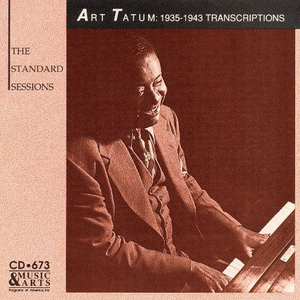
Art Tatum - The Standard Transcriptions
The Art Tatum Solo Masterpieces, Vol. 7

Collaborations

Live on Youtube

Explore Further

Selected connections
Pianist, Canada
Oscar Peterson
Peterson absorbed Tatum's velocity and built a career on it — a natural next stop for anyone dazzled by the technique.
Explore →
Album, 1954
The Art Tatum Solo Masterpieces
The Verve solo sessions are the place to start — pick any volume and you'll hear exactly what all the fuss is about.
Explore →

Who's playing
Listen next
Recording Info
Track listing
Musicians
Further Reading
Read more

Where next?

More by this artist

Albums with the same musicians

From the same era

Similar artists

inside the sleeve
Growing
Jazz, explained without pretension.
Read · Follow the connections · Press play
Right now: 7,100+ albums · 440+ artists
Start here
New to jazz? These artists are good places to start.
Loading…
Explore
Nine records worth getting lost in.
Born today
Album of the day
A landmark record, every day.
Read
  • Loading…
Article archive →
Recently added
Purpose
Inside the Sleeve is your companion on a journey through jazz — not a textbook, but something closer to a knowledgeable friend sitting next to you while you listen. Read about an artist, press play, follow a connection, discover an album you didn't know you needed.
Suggestions
Read

Articles

Essays, guides, and lists about jazz and the records that matter.

Loading…

Genre

Key Artists
Further Reading

Essential Albums

Related Genres

In This Genre

About

Inside the Sleeve

Work in progress

Inside the Sleeve grows continuously — new artists and albums are added, essays refined, as visitors explore and our editors follow up on what they find. Content, features, and design are still evolving; use the Report error button on any page to flag something that seems off.

Content

Every artist, album, and release date on Inside the Sleeve is real — verified against trusted sources including MusicBrainz and Wikipedia. We don't invent discographies or fabricate records. AI compiles that verified information into readable prose — essays on artists, albums, and the music itself. We can't manually review every essay before publishing, but every reported error is checked by a human editor.

Inside the Sleeve is not a review site. We're not here to rate or rank — we're here to guide you in. Where an album stands out, we'll say so. Where an artist changed everything, you'll know why. But we won't tear anything down. Jazz history is complex and sources sometimes disagree — if you spot something that seems off, please report it.

Streaming

Inside the Sleeve links to Spotify and Apple Music so you can listen while you read. These are not affiliate links. For Spotify, links open a search on open.spotify.com — we do not have direct links to specific recordings. For Apple Music, direct links are used where available, otherwise a search is opened.

Your choice of streaming service is stored locally in your browser only. It is never sent to our servers.

We're working on deeper Spotify integration, including direct links to specific recordings.

Privacy

Inside the Sleeve does not collect personal data and does not use cookies. We count page visits anonymously using a self-hosted analytics tool — no personal identifiers are stored, and the data never leaves our own server. The only preference stored on your device is your streaming service choice, saved locally in your browser and never transmitted.

When you submit a suggestion or error report, the text you write is stored in our database. No name or email is required or collected unless you choose to provide one.

Third-party services

Spotify and Apple Music are independent services with their own terms of use and privacy policies. Inside the Sleeve is not affiliated with or endorsed by either company.

Support

Inside the Sleeve is free and ad-free. If you enjoy it, a coffee helps cover server costs and keeps the project going.

Amazon

Some book recommendations on Inside the Sleeve link to Amazon. Buying through these links costs you nothing extra — but Amazon pays us a small commission, which goes directly towards keeping the site running. It's a simple way to support the project if you were going to buy the book anyway.

As an Amazon Associate, Inside the Sleeve earns from qualifying purchases.

Questions or feedback? Use the suggestion box on the front page.

Inside the Sleeve — A guide for those who want to go beyond the obvious About & Privacy