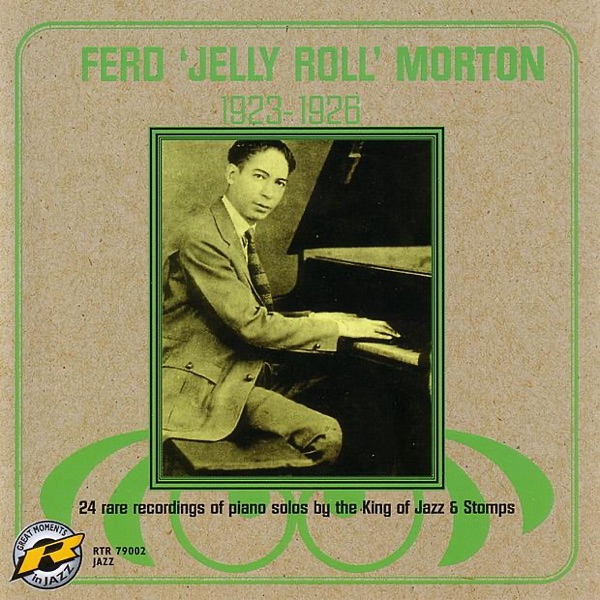
1926 · Album
Volume 1 (1923-1929)
Recorded 1926-1929 · Victor Records · Produced by Unknown
Morton in the Studio: Early Mastery Captured
These sessions show Morton inventing jazz piano language while his band locked in around him.
The studio sessions that produced these recordings happened in the middle of the 1920s, a period when Jelly Roll Morton was at the height of his powers as both composer and bandleader. He arrived with specific ideas about what he wanted to hear — arrangements were tight, parts were written or carefully rehearsed, and the ensemble had to execute them cleanly. This was not the loose, improvised feel some people associate with early jazz. Morton demanded precision. In the room with him were Kid Ory on trombone, Johnny St. Cyr on banjo, John Lindsay on double bass, and Andrew Hilaire on drums, a lineup that could deliver the kind of coordinated ensemble sound Morton had in mind. Boyd Senter appears on some tracks, adding kazoo textures that give certain numbers a distinct character.
What matters most about these recordings is how Morton's piano voice sits at the center. He was not just a bandleader here — he was a composer-arranger thinking through problems of structure, melody, and rhythm that other musicians were still figuring out. His left hand drives the music forward with deliberate purpose, and his right hand voices chords and melodic lines with clarity. The band responds to this direction, and you hear it in how crisp the ensemble passages land, how the trombone and banjo know exactly when to step back and let the piano breathe.
These sides represent early jazz at a moment when it was becoming something more intentional and organized. They are not the rawest or most spontaneous recordings of the era, but they are among the most architecturally interesting. If you want to understand how composition and arrangement entered jazz at the ground level, this is where to listen.
Who's playing
John Lindsaydouble bass
Jelly Roll Mortonpiano, solo
Kid Orytrombone
Andrew Hilairedrums
Boyd Senterkazoo
Johnny St. Cyrbanjo
George Mitchellcornet
Omer Simeonclarinet