Where do you listen?
Choose your streaming service
inside the sleeve
Loading…
inside the sleeveITS
⌕
Read About
Piano - USA - Early Jazz

Jelly Roll
Morton

1890 - 1941, USA

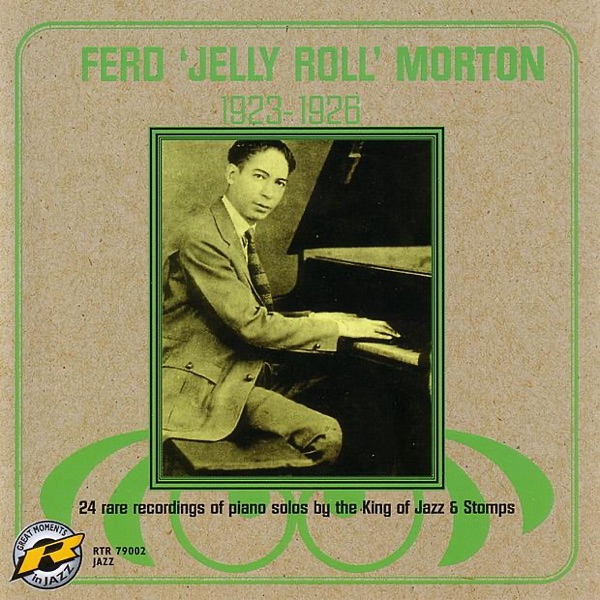
Jelly Roll Morton was one of the first people to actually think about jazz — to sit down and figure out how it worked and then write it down. He came out of New Orleans when the music was still finding its shape, and he spent the rest of his life insisting, sometimes obnoxiously, that he had invented it. He hadn't, exactly, but he understood it earlier and more deeply than almost anyone else.

Early JazzLatin Jazz
Jelly Roll Morton

The Architect Who Wouldn't Shut Up

Before we get into the music, you have to understand the man, because with Morton the two are completely tangled up. He was a braggart, a self-promoter, and a gambler who dressed in diamonds and claimed credit he didn't always deserve. He also happened to be right that he was extraordinary. His piano playing was unlike anyone else's — loose and conversational in the right hand, anchored by a New Orleans bass that kept its own kind of time — and his compositions were genuinely sophisticated in ways that his contemporaries were still working toward.

He grew up in New Orleans in the Creole community, which gave him a particular relationship to African American music and European forms at the same time. You can hear both in his playing. There's ragtime in there, sure, but also blues, Spanish tinge, march rhythms, and something looser and more improvisational that wouldn't fully have a name for another decade. When he recorded with his Red Hot Peppers in the mid-1920s, he was making small-group recordings that treated the band as a composed unit rather than just a bunch of guys taking turns. That was new.

The Red Hot Peppers sessions for Victor in 1926 and 1927 are the core of what he left behind. Jelly Roll Morton and His Red Hot Peppers (1926) is where you start. The arrangements are tight without being stiff, and Morton keeps little surprises coming — a sudden stop, a trombone smear, a tempo shift that shouldn't work but does. He thought about texture and contrast in a way that most jazz musicians of the era simply didn't, or at least didn't commit to tape. These aren't loose jam sessions. They're planned, and the planning shows.

His later years were rough. By the 1930s, swing had taken over and Morton was seen as old-fashioned, which genuinely seemed to wound him. He ended up in Washington D.C. running a small club, mostly forgotten by the industry. Then Alan Lomax tracked him down for the Library of Congress in 1938 and recorded hours of Morton talking, playing, and explaining where jazz came from. Those recordings are extraordinary — part oral history, part performance, part unreliable memoir. Morton plays snippets of everything and explains what he's doing, and even accounting for the self-mythology, there's a real intelligence at work.

If you're coming to Morton fresh, don't overthink it. Put on one of the Red Hot Peppers tracks and just listen to how the band moves together — there's a rolling, almost physical quality to the rhythm that a lot of early jazz doesn't have. Then, when you want more context, find the Lomax sessions and let Morton tell you about himself. He'll exaggerate. He'll irritate you a little. But he'll also make you hear the music differently, which was probably what he wanted all along.


Facts
BornOctober 20, 1890, New Orleans, Louisiana
DiedJuly 10, 1941, Los Angeles, California
InstrumentPiano
Active1900s - 1941
Known forRed Hot Peppers recordings, Library of Congress sessions, early jazz composition
Connections
Alan LomaxArchivist, Washington D.C.
→
King OliverContemporary, New Orleans
→
W.C. HandyContemporary, American South
→
Read more

Discography

6 records
The Pianist and Composer - Volume 1
1926
♫
Volume 1 (1923-1929)
1926
Mr. Jelly Lord
Mr. Jelly Lord
1967
♫
Transcriptions For Orchestra
1974
♫
New York, Washington and the Rediscovery - Volume 3
1991
Jelly Roll Morton Plays Jelly Roll Morton and Other Favorites
1999

Collaborations

Live on Youtube

Explore Further

Selected connections
Pianist, USA
James P. Johnson
Another architect of early jazz piano who came from a different angle — stride rather than New Orleans — and makes for a natural comparison to Morton.
Explore →
Album, 1923
King Oliver's Creole Jazz Band
Recorded the same year Morton was hitting his stride, and gives you the full picture of what New Orleans jazz sounded like when it arrived in Chicago.
Explore →

Who's playing
Listen next
Recording Info
Track listing
Musicians
Further Reading
Read more

Where next?

More by this artist

Albums with the same musicians

From the same era

Similar artists

inside the sleeve
Growing
Jazz, explained without pretension.
Read · Follow the connections · Press play
Right now: 7,100+ albums · 440+ artists
Start here
New to jazz? These artists are good places to start.
Loading…
Explore
Nine records worth getting lost in.
Born today
Album of the day
A landmark record, every day.
Read
  • Loading…
Article archive →
Recently added
Purpose
Inside the Sleeve is your companion on a journey through jazz — not a textbook, but something closer to a knowledgeable friend sitting next to you while you listen. Read about an artist, press play, follow a connection, discover an album you didn't know you needed.
Suggestions
Read

Articles

Essays, guides, and lists about jazz and the records that matter.

Loading…

Genre

Key Artists
Further Reading

Essential Albums

Related Genres

In This Genre

About

Inside the Sleeve

Work in progress

Inside the Sleeve grows continuously — new artists and albums are added, essays refined, as visitors explore and our editors follow up on what they find. Content, features, and design are still evolving; use the Report error button on any page to flag something that seems off.

Content

Every artist, album, and release date on Inside the Sleeve is real — verified against trusted sources including MusicBrainz and Wikipedia. We don't invent discographies or fabricate records. AI compiles that verified information into readable prose — essays on artists, albums, and the music itself. We can't manually review every essay before publishing, but every reported error is checked by a human editor.

Inside the Sleeve is not a review site. We're not here to rate or rank — we're here to guide you in. Where an album stands out, we'll say so. Where an artist changed everything, you'll know why. But we won't tear anything down. Jazz history is complex and sources sometimes disagree — if you spot something that seems off, please report it.

Streaming

Inside the Sleeve links to Spotify and Apple Music so you can listen while you read. These are not affiliate links. For Spotify, links open a search on open.spotify.com — we do not have direct links to specific recordings. For Apple Music, direct links are used where available, otherwise a search is opened.

Your choice of streaming service is stored locally in your browser only. It is never sent to our servers.

We're working on deeper Spotify integration, including direct links to specific recordings.

Privacy

Inside the Sleeve does not collect personal data and does not use cookies. We count page visits anonymously using a self-hosted analytics tool — no personal identifiers are stored, and the data never leaves our own server. The only preference stored on your device is your streaming service choice, saved locally in your browser and never transmitted.

When you submit a suggestion or error report, the text you write is stored in our database. No name or email is required or collected unless you choose to provide one.

Third-party services

Spotify and Apple Music are independent services with their own terms of use and privacy policies. Inside the Sleeve is not affiliated with or endorsed by either company.

Support

Inside the Sleeve is free and ad-free. If you enjoy it, a coffee helps cover server costs and keeps the project going.

Amazon

Some book recommendations on Inside the Sleeve link to Amazon. Buying through these links costs you nothing extra — but Amazon pays us a small commission, which goes directly towards keeping the site running. It's a simple way to support the project if you were going to buy the book anyway.

As an Amazon Associate, Inside the Sleeve earns from qualifying purchases.

Questions or feedback? Use the suggestion box on the front page.

Inside the Sleeve — A guide for those who want to go beyond the obvious About & Privacy