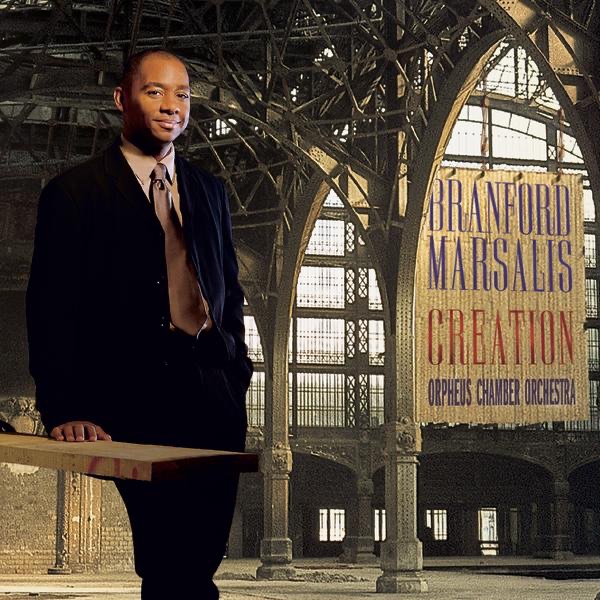
2001 · Album
Creation
Recorded March 9–11, 2000 at the American Academy of Arts and Letters, New York City · Ensemble: Branford Marsalis with the Orpheus Chamber Orchestra · Featured Composers: Darius Milhaud and Jacques Ibert
French Voices Through the Saxophone
Marsalis turns 20th century French classical pieces into something that breathes with immediacy.
Branford Marsalis has spent his career refusing easy categories, and Creation is exactly the kind of album that explains why. Recorded in March 2000, it pairs him with the Orpheus Chamber Orchestra on a focused survey of twentieth-century French classical music. The album works because Marsalis doesn't approach this material as a jazz musician playing dress-up in a concert hall. Instead, he treats Darius Milhaud and Jacques Ibert's writing—pieces composed specifically for saxophone and orchestra alongside newly arranged standards—as problems to solve rather than monuments to preserve. His tone on the horn stays warm and direct throughout, never reaching for false elegance. The orchestration sits cleanly around him without crowding, which means you hear both what he's doing and what the ensemble is doing, and how they're talking to each other.
This is not Marsalis at his most swinging or bluesy. That's the point. The French composers he's working with weren't interested in blues changes or walking bass lines, and he respects that enough not to force it. What you get instead is a saxophonist who can shift tone and approach depending on what the moment asks for—lighter and more conversational in the Ibert pieces, warmer and slightly more introspective in Milhaud. The recording itself sounds clean and immediate, with space around each instrument. You're never drowning in orchestral wash.
In Marsalis's catalog, this is a side project that pays off. Not the album to start with if you want to understand his core voice—that's something his jazz work handles better. But if you've followed him through his Columbia Records years and his later ECM releases, it's worth hearing. It shows a musician genuinely interested in where his instrument can go outside its home territory, without needing to apologize for the detour.
Who's playing
Branford Marsalissaxophone