Where do you listen?
Choose your streaming service
inside the sleeve
Loading…
inside the sleeveITS
⌕
Read About

♫

Facts
Connections
Read more

Discography

Collaborations

Live on Youtube

Explore Further

Selected connections
1976 · Album

Bright Size Life

↑ Pat Metheny

Recorded December 1975 · ECM · Produced by Manfred Eicher
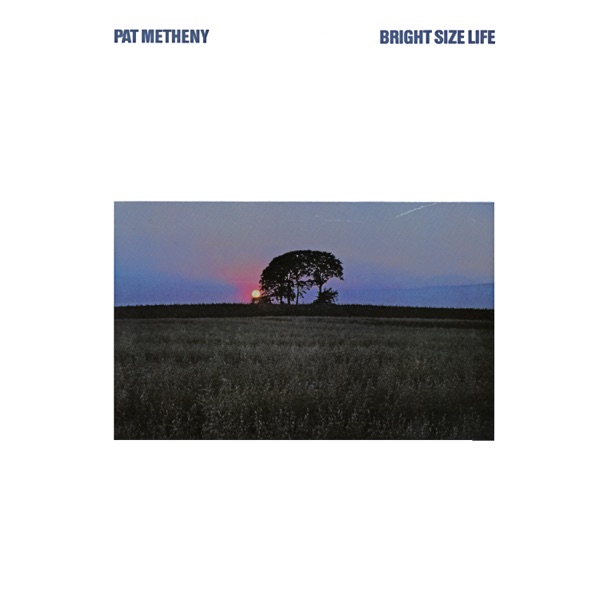
Bright Size Life

A Young Guitar Voice Arrives Fully Formed

Metheny at 21, playing with a warmth and confidence that made the future feel obvious.

When Pat Metheny walked into the studio in December 1975, he was still in his early twenties, fresh from teaching at Berklee and a stint with Gary Burton's band. Bright Size Life (1976) is the record that introduced him as a bandleader, and it holds up not as a nostalgic curiosity but as a genuinely enjoyable, cohesive album that rewards close listening. The playing is clean and melodic, the writing immediately recognizable as Metheny's own, and the whole thing has a relaxed confidence that you don't often hear on debut records. It doesn't sound like a young musician trying to prove something — it sounds like a musician who already knows what he wants to say.

The trio here is notable. Jaco Pastorius was, at the time, still largely unknown outside of South Florida, and this album served as one of his first wide exposures. His fretless bass work throughout is remarkable — fluid, singing, and harmonically engaged in a way that goes well beyond timekeeping. Bob Moses on drums rounds out the group, and the three of them play with an intimacy that suggests a working band rather than a studio assembly. The title track opens the album and sets the tone: a gentle, optimistic melody over a quietly swinging groove, Metheny's guitar tone warm and round, nothing aggressive or showy about it. 'Sirabhorn' and 'Omaha Celebration' show his writing can move between moody introspection and a more open, almost folk-inflected brightness without losing focus.

What makes this album distinct from Metheny's later work is its economy. There are no orchestras, no synthesizers, no sprawling compositions. It's a guitar, a fretless bass, and drums, and everything depends on the quality of the tunes and the conversation between the players. That conversation is genuinely good. ECM's production, characteristically spacious, gives the trio room to breathe without turning everything into atmosphere for its own sake. The album runs a modest length and doesn't overstay its welcome, which is a virtue.

This is a great record, not just a historically interesting one. If you're coming to Metheny for the first time, it's an honest place to start — you hear exactly what kind of melodist he is before all the production layers arrived. If you're already a fan, it's worth returning to for the Pastorius performances alone, which stand independently as some of his finest early work on record. The whole thing feels like a bright, clear morning: nothing complicated, nothing forced, just three musicians who suited each other well playing music they clearly believed in.

Who's playing
Jaco Pastoriusbass guitar
Bob Mosesdrums
Listen next
♫
By Pat Metheny
80/81 1980
Jaco Pastorius's own record
Jaco Pastorius 1976
Jaco Pastorius plays bass guitar here
More Jazz Fusion
Romantic Warrior 1976
Return to Forever
Recording Info
Track listing
1Bright Size Life4:46
2Sirabhorn5:30
3Unity Village3:40
4Missouri Uncompromised4:22
5Midwestern Nights Dream6:01
6Unquity Road3:35
7Omaha Celebration4:19
8Round Trip / Broadway Blues4:58
Musicians
Further Reading
Read more

Where next?

More by Pat Metheny
♫
80/81 1980
Pat Metheny Group 1977
Offramp 1982
What's It All About 2011
All 26 albums →
The musicians on this record
Jaco Pastorius 1976
Jaco Pastorius
plays bass guitar here
Their own records, close in time
More Jazz Fusion
Romantic Warrior 1976
Return to Forever
Romantic Warrior 1976
Chick Corea
Electric Rendezvous 1982
Al Di Meola
8:30 1979
Weather Report
All 140 Jazz Fusion artists →

More by this artist

Albums with the same musicians

From the same era

Similar artists

inside the sleeve
Growing
Jazz, explained without pretension.
Read · Follow the connections · Press play
Right now: 7,100+ albums · 440+ artists
Start here
New to jazz? These artists are good places to start.
Loading…
Explore
Nine records worth getting lost in.
Born today
Album of the day
A landmark record, every day.
Read
  • Loading…
Article archive →
Recently added
Purpose
Inside the Sleeve is your companion on a journey through jazz — not a textbook, but something closer to a knowledgeable friend sitting next to you while you listen. Read about an artist, press play, follow a connection, discover an album you didn't know you needed.
Suggestions
Read

Articles

Essays, guides, and lists about jazz and the records that matter.

Loading…

Genre

Key Artists
Further Reading

Essential Albums

Related Genres

In This Genre

About

Inside the Sleeve

Work in progress

Inside the Sleeve grows continuously — new artists and albums are added, essays refined, as visitors explore and our editors follow up on what they find. Content, features, and design are still evolving; use the Report error button on any page to flag something that seems off.

Content

Every artist, album, and release date on Inside the Sleeve is real — verified against trusted sources including MusicBrainz and Wikipedia. We don't invent discographies or fabricate records. AI compiles that verified information into readable prose — essays on artists, albums, and the music itself. We can't manually review every essay before publishing, but every reported error is checked by a human editor.

Inside the Sleeve is not a review site. We're not here to rate or rank — we're here to guide you in. Where an album stands out, we'll say so. Where an artist changed everything, you'll know why. But we won't tear anything down. Jazz history is complex and sources sometimes disagree — if you spot something that seems off, please report it.

Streaming

Inside the Sleeve links to Spotify and Apple Music so you can listen while you read. These are not affiliate links. For Spotify, links open a search on open.spotify.com — we do not have direct links to specific recordings. For Apple Music, direct links are used where available, otherwise a search is opened.

Your choice of streaming service is stored locally in your browser only. It is never sent to our servers.

We're working on deeper Spotify integration, including direct links to specific recordings.

Privacy

Inside the Sleeve does not collect personal data and does not use cookies. We count page visits anonymously using a self-hosted analytics tool — no personal identifiers are stored, and the data never leaves our own server. The only preference stored on your device is your streaming service choice, saved locally in your browser and never transmitted.

When you submit a suggestion or error report, the text you write is stored in our database. No name or email is required or collected unless you choose to provide one.

Third-party services

Spotify and Apple Music are independent services with their own terms of use and privacy policies. Inside the Sleeve is not affiliated with or endorsed by either company.

Support

Inside the Sleeve is free and ad-free. If you enjoy it, a coffee helps cover server costs and keeps the project going.

Amazon

Some book recommendations on Inside the Sleeve link to Amazon. Buying through these links costs you nothing extra — but Amazon pays us a small commission, which goes directly towards keeping the site running. It's a simple way to support the project if you were going to buy the book anyway.

As an Amazon Associate, Inside the Sleeve earns from qualifying purchases.

Questions or feedback? Use the suggestion box on the front page.

Inside the Sleeve — A guide for those who want to go beyond the obvious About & Privacy