2004 · Album
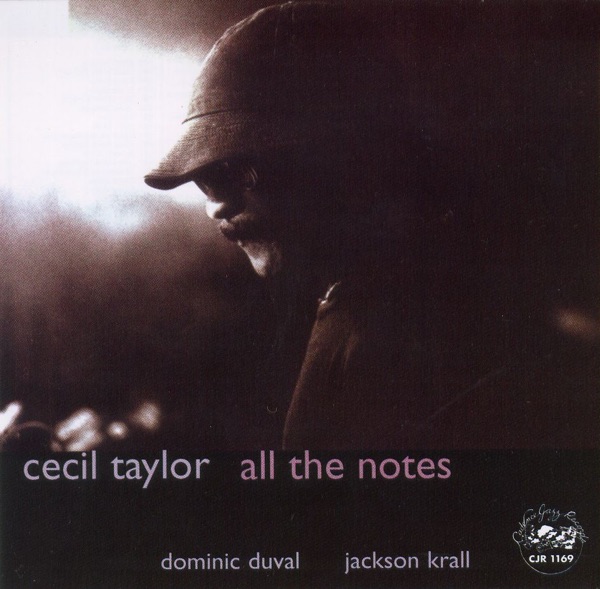
All the Notes
Recorded February 2000, Ted Mann Concert Hall, Minneapolis, Minnesota · Cadence Jazz Records · Released: 2004
Keeping Pace with Thunderous Invention
Taylor's followers will enjoy the music while those whose ears are not open to the pianist's very advanced improvising are advised to explore some of his earlier recordings first.
By 2000, Cecil Taylor had spent fifty years pursuing one of jazz's most uncompromising paths — dense, torrential piano that operated by its own harmonic logic. At eighty-two, he showed no signs of softening or clarifying his approach. What makes All the Notes distinctive is how bassist Dominic Duval and drummer Jackson Krall respond to that refusal to simplify. They don't try to ground Taylor or pull him toward conventional time-keeping. Instead, they work to match his intensity, which means abandoning the usual scaffolding of bass lines and drums altogether. Duval follows Taylor's abstraction note by note, responding rather than comping. Krall does his best to keep up with the fractured rhythms, though as AllMusic reviewer Scott Yanow noted, there's no question who the leader is.
The album consists of three long improvisations recorded live at the Ted Mann Concert Hall. Taylor builds from the most abstract harmonic ideas, somehow making it all cohere, even when the harmonic language would seem to resist coherence. His technique and endurance at this stage of his life remain extraordinary. The performance is mostly thunderous, though brief lyrical moments emerge — quieter passages where the density drops and you can hear the three voices more clearly.
This is a record for committed listeners. Taylor's earlier work, particularly recordings from his Blue Note period, offers more accessible entry points. But for those already invested in his aesthetic, All the Notes documents an artist still fully engaged with his own vision, still capable of finding new elaborations within it, still surrounded by musicians willing to follow him into unfamiliar territory.
Who's playing
Where next?
More by Cecil Taylor
All 77 albums →