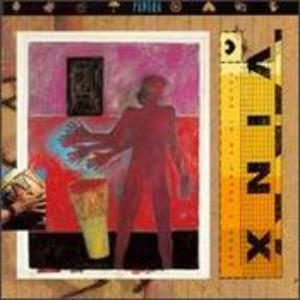
The Athlete Who Chose Rhythm
Before most people had heard his name, Vinx was already remarkable — a competitive decathlete who trained alongside Carl Lewis and represented the United States at an elite level. That physical discipline, the kind that demands total body awareness and timing down to the fraction of a second, never really left him when he moved into music. You can hear it in the way he locks into a groove: nothing is wasted, every beat lands with intention.
What Vinx actually sounds like is harder to summarize than you might expect. He sings with a deep, rich baritone that owes something to Bobby McFerrin — both in its agility and its willingness to treat the voice as a percussion instrument — but Vinx is earthier, more rooted in funk and African American vernacular music. His conga playing is central to everything he does, and often he performs with just his voice and drums, building textures that feel surprisingly full for one person.
His albums from the early 1990s, made under the wing of Sting — who signed him to his Pangaea label — introduced him to a wider audience. Sting was genuinely enthusiastic about Vinx's talent, and the association brought visibility, but the music itself stood on its own. The Eyes of Wynton and other recordings from that period show an artist comfortable straddling jazz, world music, and soul without making it feel like a forced fusion exercise. The grooves feel natural because, for Vinx, they are.
He has collaborated with an impressive range of musicians over the years, including Herbie Hancock and Branford Marsalis, and he has appeared on sessions that run from straightforward jazz to more experimental territory. But Vinx is fundamentally a live performer, and recordings only partially capture what he does. The interactive quality of his music — the way he draws listeners in, plays with call and response, makes something communal out of what could be a solo performance — is where his work really comes alive.
Vinx is the kind of artist who rewards a curious listener precisely because there is no hype machinery keeping his name in circulation. If you come to him expecting something polished and commercially smooth, you might be surprised by how raw and direct his music feels. If you come to him open to something genuinely rhythmic, personal, and a little hard to categorize, you are likely to find him unforgettable.