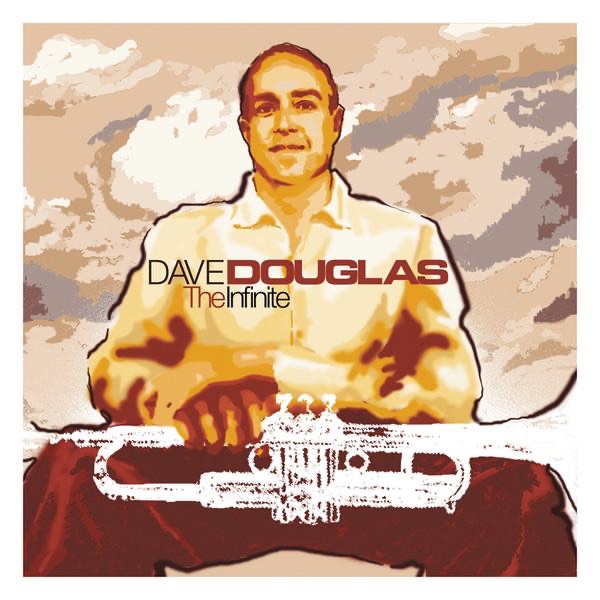
Dance and Improvisation in Tandem Motion
Douglas trades the trio format for a chamber ensemble built around a dancer's sense of space and timing.
By 2001, Dave Douglas had already established himself as a restless experimenter — someone uninterested in the hard bebop lane or the mainstream jazz orthodoxy. El Trilogy sits at a particular point in that trajectory: not a debut, not a full departure, but a commission that pulled him sideways into unfamiliar territory. The music was written for the Trisha Brown Dance Company, and that source reshapes everything about how the ensemble moves.
Douglas leads a six-piece: Greg Cohen on bass, Gregory Tardy on tenor, Mark Feldman on violin, Guy Klucevsek on accordion, and Susie Ibarra on drums and percussion. That lineup alone signals something different — the violin and accordion are not your standard jazz voices, and together with Feldman and Klucevsek they pull the sound toward something more textural, more architectural. This is not a rhythm section with horns on top. It is an ensemble where melody and accompaniment trade places constantly, where the drums might be keeping time while the accordion runs figures underneath, or where Feldman's lines weave through Cohen's walking patterns without ever quite resolving into traditional chord changes.
The commission meant Douglas had to think in terms of dancers moving through space rather than soloists trading choruses. That constraint appears to have freed something — the tracks feel less concerned with proving harmonic complexity than with finding shapes that can sustain themselves across time. It is chamber music played by jazz musicians, or jazz played by musicians trained in compositional craft. Either way, it stands apart from Douglas's other work of the period, less about velocity or virtuosity and more about listening to what happens when six voices occupy the same space without rushing to state their business.
Who's playing
Greg Cohenbass
Gregory Tardytenor saxophone
Dave Douglastrumpet
Susie Ibarradrums, percussion
Mark Feldmanviolin
Guy Klucevsekaccordion